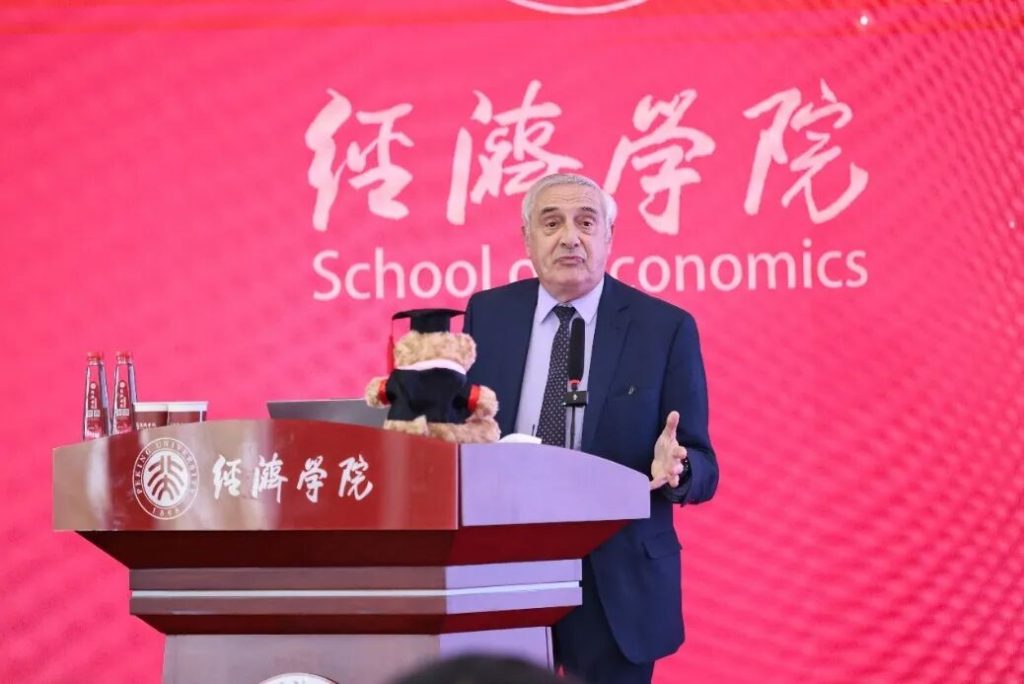
On October 24, the 2025 Nobel Prize in Economics winner Robert M. Joel Mokyr, H. Stotts Professor of Humanities, visits Peking University. He Guangcai, Secretary of the Party Committee and Chairman of the School Affairs Committee, met with guests at the School of Economics. School leaders accompanied the meeting.
He Guangguang welcomed Mokiel to his visit and congratulated him on winning the 2025 Nobel Prize in Economics. He pointed out that Mokir's interpretation of innovation-driven economic growth theory provides a solid theoretical foundation for understanding modern economic prosperity. Peking University has deeply studied and implemented Xi Jinping Thought on Diplomacy, promoted the opening up of high-level education, deepened international cooperation and exchanges in basic disciplines, and accelerated the construction of an important education center with global influence.
The university will further strengthen exchanges and cooperation with top international scholars such as Professor Mokir, promote the combination of cutting-edge theories and the theory and practice of Chinese-style modernization, deepen exchanges and mutual learning among civilizations, and jointly write a new chapter in a community with a shared future for mankind. Mokyll thanked Peking University for its warm reception and spoke highly of Peking University's academic level and talent training quality. He pointed out that the current global economic development requires more interdisciplinary and cross-border academic exchanges and ideological collisions. We are willing to carry out regular cooperation with Peking University, promote the common academic development of the United States and China through exchanges, and help the two sides deepen cooperation and exchanges on important global issues such as climate change and population governance.
On the same day, Mokill gave an academic lecture entitled "The Industrial Revolution and the Origins of Modern Economic Growth: A New Look".
Mokill re-examined the reasons why the British Industrial Revolution became the starting point of modern economic growth, emphasizing that the essence of the industrial revolution was the application of "practical knowledge", and the core was the ability to implement technology rather than simple invention. The interconnection between skills supply, institutional environment and market demand promotes the British economy to form a positive feedback loop of income improvement and technological progress, helping the industrial revolution become the starting point of modern economic growth.
The event was jointly organized by the School of Economics and the Ministry of International Cooperation, and supported by the "University Hall" Top Scholars Lecture Program of Peking University.
About the speaker:
Joel Mokyr, 2025 Nobel Prize winner in economics, Robert M. Mokyr, Northwestern University in the United States. H. Stotts Professor of Humanities, Professor of Economics and History, Professor of Economics at Tel Aviv University's Ethan Berglas School of Economics. Mokill is currently the editor-in-chief of the Princeton Western Economic History Series, and has served as editor-in-chief of the Journal of Economic History, a top academic journal on economic history, and president of the American Society for Economic History. He is the recipient of the American Economic Union Distinguished Fellowship Award, the Heineken Prize in History from the Royal Netherlands Academy of Sciences, and the International Balzan Prize for Economic History.
In 2018, he was elected a Distinguished Fellow of the American Economic Association. Mokill has published several books, including Lever of Riches, Why Ireland Starved, The Enlightened Economy, The Gifts of Athena, and A Culture of Growth.
He is the scholar whose works have been translated into Chinese the most among contemporary foreign economic historians. Mokiel has good academic exchanges with Peking University. In July 2015, he came to the university to participate in the 3rd Quantitative History Workshop and the 3rd International Conference on Quantitative History Research funded by the "Peking University Overseas Masters Lecture Program" to discuss the key drivers of the Great Divergence and economic growth with teachers and students. In December 2021, with the funding of the "Peking University High-end Lecture Program", he held three online lectures at the School of Economics, and had in-depth exchanges with teachers and students on topics such as the industrial revolution, knowledge economy, and "great prosperity", which received widespread attention and praise.