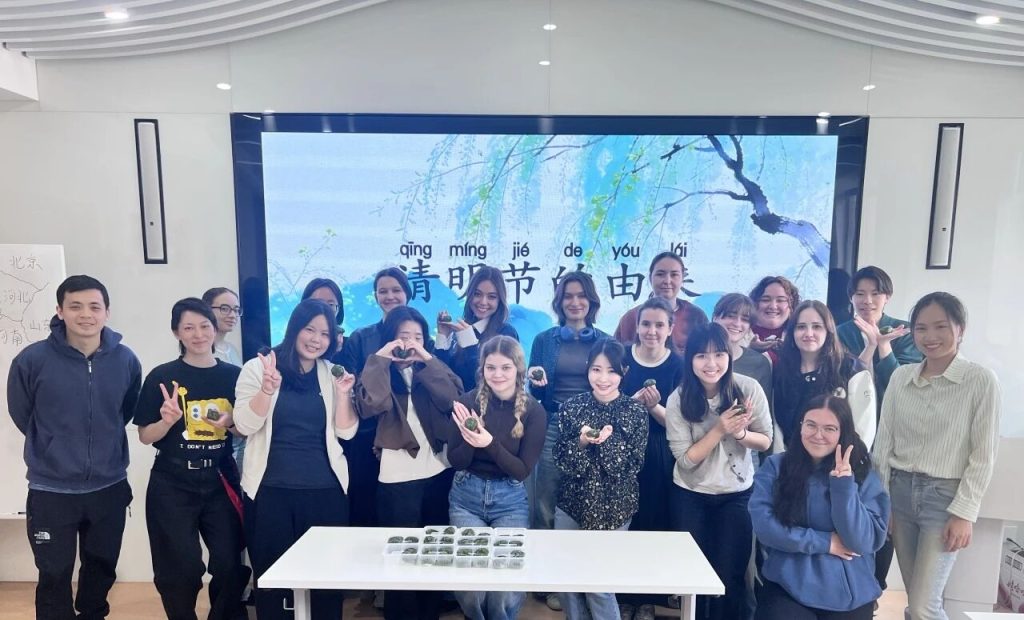
Qingming Festival, also known as Taqing Festival (Treading on the Green), Xingqing Festival, March Festival, and Ancestor Worship Festival, is an ancient festival of the Chinese nation and one of the most important sacrificial festivals. It is a day for worshipping ancestors and sweeping tombs, embodying the traditional virtues of the Chinese nation in respecting ancestors and valuing the family. During the reading club, international exchange students learned about China’s four major festivals and the knowledge of the 24 Solar Terms. Qingming is precisely the fifth solar term of spring, marking the end of mid-spring and the beginning of late spring. It is not only a solemn festival for tomb-sweeping and ancestor worship but also a festival where all living things grow vigorously, and spring plowing and planting enter a critical period. Breaking away from traditional lecturing models, this reading club adopted a diversified format of “Experience + Learning + Interaction,” allowing international exchange students to fully feel the unique charm of Qingming culture.
The activity prepared Qingtuan (Green Glutinous Rice Balls), which are both aesthetically pleasing and flavorful, for the students. Everyone picked up the Qingtuan with their own hands and took photos to commemorate the moment. Subsequently, everyone watched a video on the production of Qingtuan to intuitively understand the making process of this traditional delicacy. They then answered the question “Where does the green of Qingtuan come from?” through fun cards: it turns out that the emerald green color of Qingtuan comes from the juice extracted from the natural plant mugwort (Artemisia argyi). This is not only natural and healthy but also contains the dietary wisdom of the ancients in “complying with the four seasons.” This wisp of natural green is precisely the taste of spring and the exclusive mark of Qingming. In addition to Qingtuan, various other green foods and dishes during the Qingming period were specifically introduced at the scene, such as chives and bamboo shoots, showcasing the diversity of Chinese culture from a culinary perspective and initiating a journey of cultural exploration.
Subsequently, the reading club focused on the extension of Qingming culture, providing a detailed introduction to the closely related Cold Food Festival (Hanshi Festival) and Shangsi Festival. The Cold Food Festival originated from the remembrance of Jie Zitui, involving the prohibition of fire and the consumption of cold food; through years of evolution, its customs gradually merged with Qingming. The Shangsi Festival was the most important festival in ancient times for the “Fuchu Panyu” (riverside ritual cleansing) activity. People went to the waterside together to bathe, a practice called “Fuxi.” Later, contents such as sacrificial banquets, Qu Shui Liu Shang (floating wine cups along the winding water), and spring outings in the countryside were added. These festivals all contain rich cultural connotations, reflecting the diversity and inclusiveness of Chinese culture.
Afterward, the students appreciated and read the poem “Qingming” by the Tang Dynasty poet Du Mu together. Using concise and bright language, the poem depicts the scenes and people’s emotions during the Qingming period, allowing the international students to appreciate the atmosphere of Qingming. They expressed one after another that these poems not only helped them better understand the cultural connotations of the Qingming Festival but also stimulated their strong interest in Chinese culture.
During the exchange session, students shared similar cultural customs from their respective countries. Students from Russia brought stories about the traditional day of their motherland, “Радоница” (Radonitsa). People gather at the burial sites of their ancestors, bringing fresh flowers, prayers, and memories. At the same time, this festival combines the tradition of celebrating the resurrection of Christ in the Christian faith, blending the joy of celebrating life with sorrowful remembrance. Students from Spain and Peru talked about the traditional festivals of Latin American countries, “Día de los Muertos” (Day of the Dead) and “Día de Todos los Santos” (All Saints’ Day). During these festivals, people commemorate deceased relatives and ancestors by building altars and placing sugar skulls, candlelight, and fresh flowers. Some countries also hold grand parades and gatherings. Just as China’s Qingming Festival emphasizes inheritance, respecting ancestors, and gratitude, all cultures collectively reflect the value people place on family, emotions, and traditions.
Finally, students carried out online tomb-sweeping activities through the “Cloud Remembrance” (Yunshang Sinian) mini-program, allowing everyone to offer virtual flowers and blessings to the people they most want to commemorate. In the current digital age, this provides a more convenient way to convey grief and allows students to deeply understand the core connotation of Qingming—”worshipping ancestors and respecting relatives.” No matter how the form changes, the remembrance and gratitude for relatives and ancestors remain unchanged.
The Peking University International Exchange Students’ Qingming Festival Reading Club is a part of the “China National Conditions Education” series for exchange students. It not only allowed international students to deeply feel the extensive, profound, and unique charm of Chinese culture but also promoted exchange between different cultures, deepening mutual friendship and understanding, and making a greater contribution to enhancing friendship and cultural exchange between China and foreign countries.