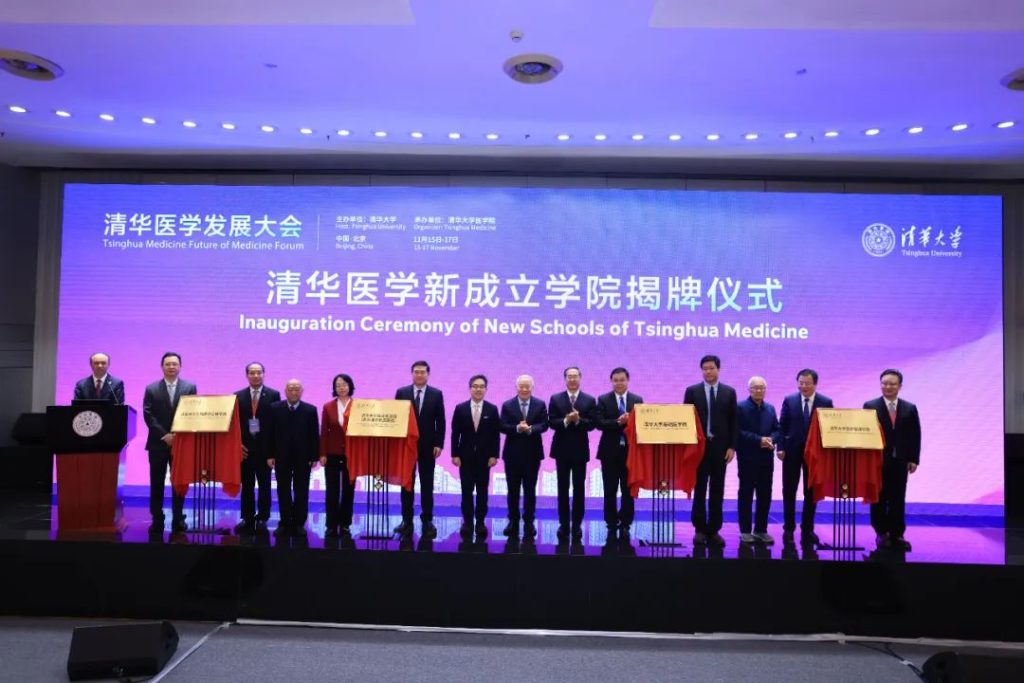
In recent years, Tsinghua University has made frequent moves to develop medicine. There are people with a perfect medical discipline system and outstanding advantages in the combination of medicine and engineering, and the construction of medical disciplines at Tsinghua University is ambitious. Tsinghua University said that it will aim to build a world-class medical discipline and meet the new situation, new challenges and new tasks of the future medical industry with new concepts, new systems and new measures. Huang Tianyin, the current dean of Tsinghua University School of Medicine, said that it is necessary to "let the world see Tsinghua medicine".
Medical school has always been the top priority of discipline construction in colleges and universities. As the absolute top of domestic universities, Tsinghua University has always had a "weakness" - the strength of medical disciplines needs to be raised to a higher level. After many years of walking with Peking Union Medical College, Tsinghua University finally decided to speed up its pace and move frequently: two years ago, Tsinghua University built its own medical department (headquarters), and this year it gained its first affiliated tertiary hospital. Recently, it has unveiled 4 new colleges in one go, increased the number of teaching and research institutions to 6, built Tsinghua Medical Park, and ushered in academician deans......
In a press release, Tsinghua University said: Tsinghua Medical will aim to build a world-class medical discipline and uphold the development ideas of innovation, leadership, internationality and integration...... Explore the development trend of new medicine rooted in China and facing the world, and meet the new situation, new challenges and new tasks of the future medical industry with new concepts, new systems and new measures.
Tsinghua Medicine is "ambitious"
A few days ago, Tsinghua University held a medical development conference. The conference itself did not go out of the circle, but there were several blockbuster actions on the Internet. First, four new colleges have been established, namely the School of Basic Medicine, the School of Biomedical Engineering, the School of Medical Management, and the School of Clinical Medicine (Beijing Tsinghua Chang Gung Hospital). These newly established colleges, together with the original School of Pharmacy and the Institute of Organ Transplantation and Bionics, form the teaching and research institutions of Tsinghua University School of Medicine. So far, the teaching and research institutions of Tsinghua University School of Medicine (Headquarters) have become 6. The second is to sign a strategic cooperation agreement with Haidian District to jointly build Tsinghua Medical Park. This move marks a substantial step in the construction of Tsinghua Medical Park. The signing of this agreement is another deepening of cooperation between Haidian District and Tsinghua University around the medical field after jointly building an artificial intelligence industry highland.
It is reported that Tsinghua Medical Park is located in the north of Haidian and covers an area of 500 acres. Including Tsinghua Medical College, research hospital and other functional positioning, to create an "academic medical system" for future medicine. In addition, Tsinghua University has also hired Cao Wenkai, president of the National Academy of Medicine and foreign academician of the Chinese Academy of Engineering, as an honorary professor. Cao Wenkai has outstanding achievements and extensive influence in the field of medicine, making pioneering contributions to cardiovascular medicine and genetics, and making numerous academic achievements in the fields of gene therapy for cardiovascular diseases and stem cell regenerative medicine. Three years ago, Huang Tianyin, a foreign academician of the National Academy of Medicine and vice provost of Tsinghua University, joined full-time and is now the dean of Tsinghua University School of Medicine. Huang Tianyin is well-known in the medical community, the world's top physician scientist, a world-renowned ophthalmologist, and an internationally renowned medical education expert...... He has won the American Academy of Ophthalmology Senior Achievement Award and the Asia-Pacific Ophthalmological Association Senior Achievement Award. He is also a Fellow of the National Academy of Sciences of Singapore and President of the Asia-Pacific Ophthalmological Imaging Society...... On November 14, the day before the Medical Development Conference, Tsinghua University and the Chaoyang District Government of Beijing signed an agreement to cooperate in the construction of Beijing Huaxin Hospital (the First Affiliated Hospital of Tsinghua University) and Beijing Chuiyangliu Hospital.
As early as 2012, the two sides signed the first agreement to cooperate in the construction of the two hospitals. This renewal is another important measure for the two sides to deepen school-local cooperation. On the same day, Beijing Tsinghua Chang Gung Hospital announced the appointment of a new administrative leadership team, and Dong Jiahong, academician of the Chinese Academy of Engineering, was appointed as the president of the Clinical Medical School of Tsinghua University (Beijing Tsinghua Chang Gung Hospital). These actions are done in one go. There are people, land, and a more complete medical discipline system. The construction of medical disciplines at Tsinghua University is ambitious.
Walking alone in the rivers and lakes, self-reliant
This ambition is in line with Tsinghua University's goal of "entering the forefront of world-class universities by 2030 and becoming the world's top university around 2050". At the recent medical development conference, Li Luming, president of Tsinghua University, also said that strengthening the construction of medical disciplines is an indispensable and important part of the construction of world-class universities. Even in China, colleges and universities have set off a "medical school boom" in recent years. According to public data, at least 37 of the 42 first-class universities in China have been built or are preparing to build medical schools.
However, in the "rivers and lakes" of domestic medical schools, Tsinghua University, as the strongest 985 university, does not rank C. In some market rankings, Tsinghua Medical College is often a few steps away from being "far ahead". For example, top medical schools require clinical practice in addition to basic medical research. The development of the medical school is also inseparable from the full assistance of the directly affiliated hospitals. Looking at the whole of Beijing, Xiehe, Peking University, and First Medical College stand together, and the "Tsinghua Department" can only be regarded as still "rising". There are 20 excellent hospitals such as Xuanwu Hospital, Temple of Heaven Hospital, and Chaoyang Hospital, Peking University Medical School has 10 top hospitals such as Peking University Hospital, Peking University People's Hospital, and the Third Hospital of Peking Medical University, and Xiehe also has 6 hospitals including Peking Union Medical College Hospital and Fuwai Hospital. There are only 4 affiliated hospitals of Tsinghua Medicine, namely Beijing Huaxin Hospital (the First Affiliated Hospital of Tsinghua University), Yuquan Hospital of Tsinghua University (Tsinghua University Hospital of Integrated Traditional Chinese and Western Medicine), Beijing Tsinghua Chang Gung Hospital, and Beijing Chuiyangliu Hospital. In particular, Tsinghua University School of Medicine lacks affiliated tertiary hospitals. In May 2024, after Yuquan Hospital of Tsinghua University was promoted to a third-class hospital of integrated traditional Chinese and Western medicine, it finally had its first "top three" hospital.
In fact, Tsinghua Medicine started not too late. In October 2001, Tsinghua University School of Medicine was established and has been established for 23 years. The first president was Wu Jieping, a famous medical scientist and academician of the Chinese Academy of Sciences. Professor Zhao Nanming, a biophysicist, Academician Shi Yigong, a structural biologist, Professor Lu Bai, a neuroscientist, and Professor Dong Chen, an immunologist, have served as executive vice presidents. For more than 20 years, the reason why Tsinghua medicine has not made great strides has been attributed to a "marriage" between Tsinghua University and Peking Union Medical College. Around 2000, there was a wave of university mergers in China. Tongji was merged into Huazhong University of Science and Technology, Xiangya was merged into Central South University, Qilu was merged into Shandong University, and West China was merged into Sichuan University...... In Beijing, the hospital has also been divided by old medical schools. Only Union Medical College of China and Beijing Medical University developed independently. Later, Beijing Medical University and Peking University cooperated to establish the "deep integration and development" of Peking University School of Medicine, which made great progress in Peking University medicine.
On September 5, 2006, the "Conference and Unveiling Ceremony of the Ministry of Education and the Ministry of Health to Jointly Build Peking Union Medical College (Tsinghua University School of Medicine)" was held, and everything seemed to be settled. One is a top university in China, and the other is a palace-level medical school, which can be a win-win situation in theory, but peers have only "held hands" for many years, not "marriage", and the relationship is more at the level of "cooperative schooling". Tsinghua decided to run its own medical treatment and develop the "Tsinghua Medical System", so Tsinghua University decided to speed up its pace as mentioned at the beginning of the article, and has made frequent moves in recent years.
However, the road to "independent medical care" is destined to be arduous, and even Tsinghua University will not be an exception.
The characteristics of the "Tsinghua Medical System" show their true faces
Fortunately, Tsinghua University naturally has unique advantages in running medical schools. As a top comprehensive university, Tsinghua University has a relatively complete range of disciplines and dense specialties, which can provide rich soil for the development of medicine and provide an ideal platform for the cross-integration of medicine and other disciplines. In recent years, it is not new for domestic medical schools to cooperate with comprehensive universities to integrate medicine and engineering and interdisciplinary training for medical students. Tsinghua University, as the top of science and engineering, is naturally better. Zeng Yixin, deputy secretary of the party group of the National Health Commission and academician of the Chinese Academy of Sciences, said in his speech at the Tsinghua Medical Development Conference that he hoped that Tsinghua medical education would find the correct positioning, actively give full play to the advantages of a comprehensive university, and promote the cross-integration of medicine and multidisciplinary. The information released by Tsinghua University also shows that after the restructuring, Tsinghua University School of Medicine will give full play to the advantages of a comprehensive university and build a "Tsinghua Medical System" led by scientific and technological innovation, driven by engineering technology, guided by clinical needs, and characterized by digital empowerment. At present, Tsinghua University is actively exploring new models of medical science and technology innovation and cooperation, especially in artificial intelligence to empower medical education and teaching. At the high-quality development forum for the 10th anniversary of the founding of Beijing Tsinghua Chang Gung Hospital held on November 16, Beijing Tsinghua Chang Gung Hospital announced that it would jointly establish the "Kunmeng AI Hospital Alliance" with 10 leading enterprises and research institutions in the field of information technology. In the past two days, the "Tsinghua AI Hospital" application has been launched under the Intelligent Industry Research Institute (AIR) of Tsinghua University, inviting professionals to conduct internal tests on the disease diagnosis ability of AI doctors. It is said that the first batch of 42 AI doctors from 21 departments can see more than 300 diseases. Tsinghua University also said that in the future, it will further give full play to the outstanding advantages of the combination of medicine and engineering, improve the layout of basic medical disciplines, and develop clinical medicine, medical management, pharmacy, biomedical engineering and other disciplines; Strengthen the construction of public health and preventive medicine, focus on promoting the integration of medicine and engineering and interdisciplinary, and promote the integration of medicine, science, engineering, humanities and social sciences. Perhaps in the near future, the world can see Tsinghua medicine as Huang Tianyin, president of Tsinghua Medical College, hopes.