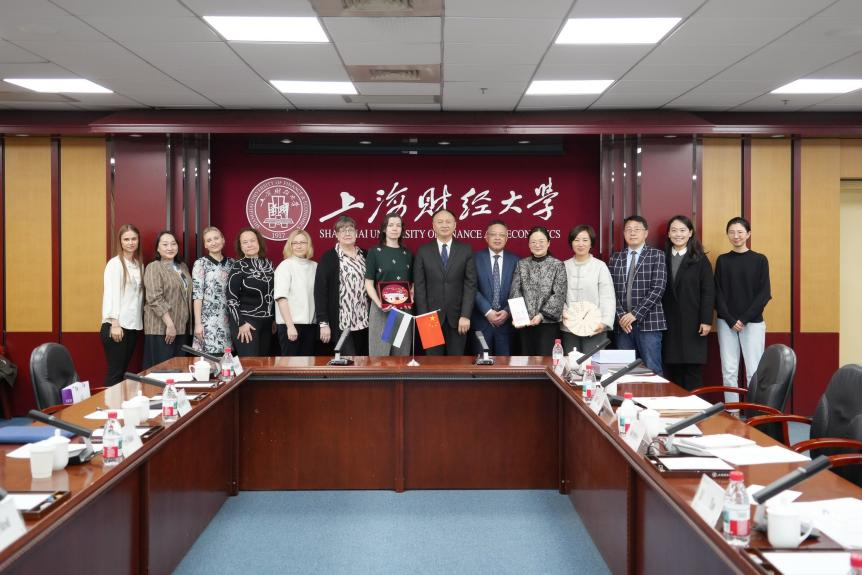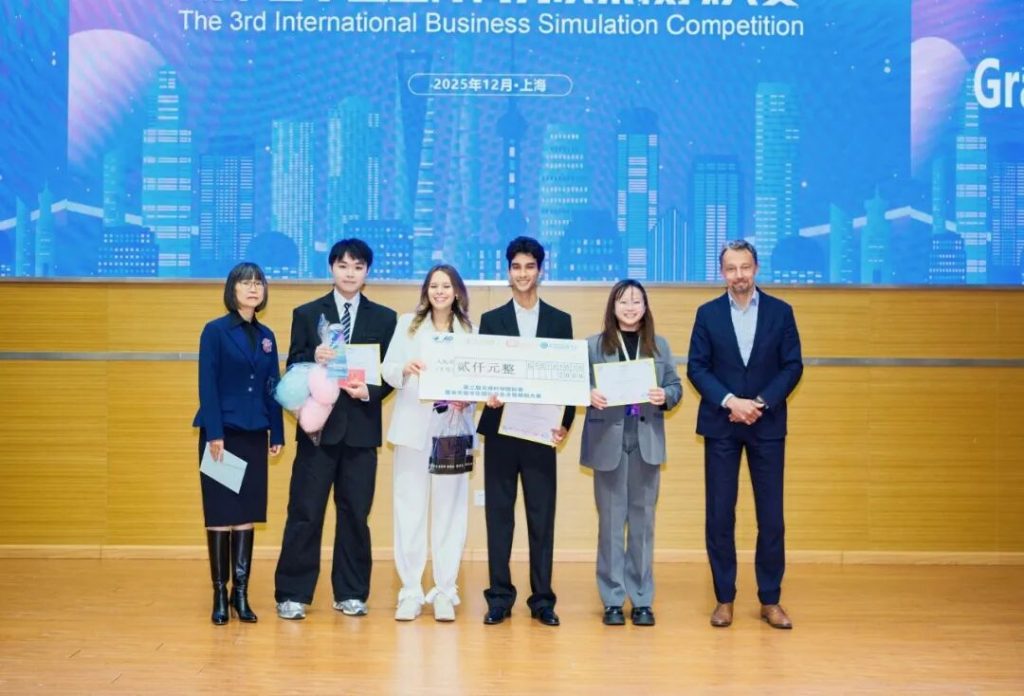
From December 2 to 3, the 3rd International Business Decision Simulation Competition for International Students in China and the finals of the Peak Moment International Competition were held at Shanghai University of Finance and Economics (SUFE). This event was organized by the Shanghai Education Association for International Exchange, and co-hosted by the School of International Cultural Exchange of SUFE and the organizing committee of Peak Moment, a global simulation competition platform.
This competition attracted 140 teams (450 participants) from 25 universities across the country, with participants representing 74 countries. Among them, 33 teams from 22 universities advanced to the finals after excelling in the preliminary round. Finally, the team "ABOSLUTE FOUR" from Shenzhen University won the national championship.
On the morning of December 2, the opening ceremony of the finals was held at the Entrepreneurship Center of Shanghai University of Finance and Economics. Attendees included SUFE Vice President Yao Lingzhen, President Jiang Haishan of the Shanghai Education Association for International Exchange, Yang Hong (Party Secretary of SUFE's School of International Cultural Exchange), Dong Jing (Dean of the same school), Veijo Kyösti (Global CEO of CESIM and Practical Teaching Consultant to the Finnish Ministry of Education), Wu Wen (General Manager of CESIM China), finalist team members, instructors, observers, competition organizing committee members, and event volunteers.
Vice President Yao Lingzhen first extended a warm welcome to the participating teams and instructors from universities across the country on behalf of SUFE. She noted that as one of China's earliest business universities, SUFE has always upheld its motto "Virtue, Knowledge, Economy for the Times," continued its business tradition, and contributed wisdom and strength to the development of China's finance and economics education. While adhering to its original mission of education, the university has also proactively responded to changes in the digital intelligence era, actively implemented the "Digital Intelligence New Finance and Economics" strategy, and launched a series of cutting-edge achievements including the Kuangshi Finance and Economics Education Large Model 2.0 and the Financial Reasoning R1 Large Model, promoting interdisciplinary integration and scenario-driven innovation in talent cultivation. She particularly pointed out that the "AI Coach" introduced in this competition is an innovative exploration of deep integration of artificial intelligence and competition practice during the university's digitalization process.
President Jiang Haishan expressed heartfelt gratitude on behalf of the organizer for the strong support from universities across the country and the enthusiastic response from international students in China. He stated that hosting the International Business Decision Simulation Competition for International Students is of great significance, providing an important way for college students to enhance their decision-making, communication, and collaboration skills, as well as expand their global horizons. He emphasized that this competition not only focuses on cultivating business competition and management abilities but also actively integrates the concepts of sustainable development and social responsibility. He hoped that all finalist teams would cherish this opportunity, approach it with an open and collaborative mindset, a passion for knowledge, and the courage to explore unknown fields, thus gaining valuable experience and growth.
Veijo Kyösti thanked the organizer and SUFE for their strong support. He pointed out that although artificial intelligence is evolving rapidly, those who truly make good use of it are still rare; the key lies in "questioning" — not asking AI for standard answers, but using AI to stimulate thinking. During this process, participants need to activate their metacognition simultaneously and be alert to "automention bias." He looked forward to seeing participants in this competition skillfully harness AI, unlock its true potential, and return with fruitful results.
The simulation competition was held on December 2. Participants collaborated with each other, explored continuously, and flexibly applied their knowledge to make decisions, fully demonstrating their creativity and business acumen. Seongwon Lee (from South Korea), a student majoring in Chinese Language and Business at East China Normal University, said: "Understanding the competition schedule is very important. The most essential factor for case success is teamwork and communication within the team; the team should have a unified value to achieve the final goal. This competition also gave me the opportunity to learn about the ideas and styles of other participants. I hope the competition will receive more publicity in the future."
Team introductions and strategy presentations took place on December 3. Invited judges including Mr. Veijo Kyösti (Global CEO of Cesim), Professor Cao Shengrong (Shanghai National Accounting Institute), and Ms. Yuan Lu (Head of Financial Business Partnering at AbbVie China) commented on the participants' excellent performances respectively.
The Peak Moment International Competition was first launched for international students in China nationwide in 2023. This year, the competition's influence continues to expand, showing an unprecedented scale and internationalization level. Zhen Li (Egypt), from the Engineering Management major at Jiangnan University, said: "We have made full preparations for this competition. There are many competitors, and we observed strategies for different market applications before receiving the case. In this final case, we attached great importance to controlling market share, so we conducted detailed market analysis for different products. For this group presentation, I think we have achieved the expected level of completion, and we have done very well."
This year's SUFE competition continues the cross-college and cross-disciplinary team formation model. On the basis of emphasizing international vision and practical education, it pays more attention to integrating digital intelligence applications and corporate social responsibility into the competition design. By introducing sustainable development scenarios and responsibility-oriented decision-making links, it guides students to think about the social value and environmental impact of business behaviors in simulated actual combat, and promotes the in-depth integration of talent cultivation with industrial needs, technological innovation, and social responsibility.
In the face of the profound changes in the digital intelligence era, Shanghai University of Finance and Economics actively implements the "Digital Intelligence New Finance and Economics" strategy, and has taken the lead in carrying out a series of innovative practices of AI-enabled finance and economics education among finance and economics universities nationwide. This year's competition relies on a digital simulation platform and innovatively introduces "AI Coach", which provides real-time guidance clues and multi-dimensional analysis for participating students throughout the business simulation decision-making process, effectively deepening their ability to combine business theory with practical application. Through highly realistic international business decision-making cases, the competition focuses on promoting participants to achieve cognitive upgrading from theory to practice, and comprehensively improving the metacognition and international analysis ability of international students in China in business decision-making.
Li Kexin (Thailand), currently pursuing a Master of International Business in English at Shanghai University of Finance and Economics, said: "Artificial intelligence technology is constantly developing, and we also used the 'AI Coach' introduced in this competition. When implementing strategies such as market research and advertising investment, some of its suggestions were very helpful to us. On this basis, combined with the actual needs of our group, we continuously adjusted our strategies and improved our plan." "This competition is a rare opportunity. We have the opportunity to truly apply and absorb what we have learned, and also accumulate valuable experience for our future study and career development. After the competition, we will review, learn from the experience, and participate in similar competitions in the future." added Bassem Hamed (Egypt), a Master of International Business in English at Shanghai University of Finance and Economics.
This year's SUFE | CESIM competition not only promotes the development of business simulation education in the digital intelligence era and lays a solid foundation for cultivating business talents with international vision, but also further promotes the use of Chinese in the international business context. The competition guides students to pay attention to the social significance and environmental impact of enterprise development, establishes a responsibility-oriented innovation spirit, and shapes the distinctive characteristics of international student education in China. In a multicultural communication atmosphere, international students from different countries, schools and professional backgrounds can deeply integrate at the academic and cultural levels, and jointly contribute to the development of international student education in China to a higher level.
Shanghai University of Finance and Economics (Shanghai University of Finance and Economics)
It is abbreviated as Shanghai University of Finance and Economics or SUFE, located in Shanghai. The university is co-built by the Ministry of Education of the People's Republic of China, the Ministry of Finance of the People's Republic of China (hereinafter referred to as the Ministry of Finance) and the Shanghai Municipal People's Government. It is a key university directly under the Ministry of Education of the People's Republic of China, a multi-disciplinary key university focusing on economic management disciplines with coordinated development of economics, management, law, arts, science and engineering. It is selected into the national "Double First-Class" initiative, "211 Project" and "Excellent Discipline Innovation Platform".
Shanghai University of Finance and Economics originated from the business department established by Nanjing Higher Normal School in 1917. In 1921, the business department was expanded, reorganized and moved to Shanghai, and the Shanghai Commercial College affiliated to National Southeast University was established. In 1932, it became an independent university, named National Shanghai Commercial College. In 1950, it was renamed Shanghai College of Finance and Economics. In 1985, it was renamed Shanghai University of Finance and Economics. In 1996, it became a key construction university of the national "211 Project". In 2000, the university was transferred from the Ministry of Finance to the leadership of the Ministry of Education. In 2006, it became a construction university of the national "Excellent Discipline Innovation Platform". In 2017, the university entered the national "Double First-Class" construction sequence.