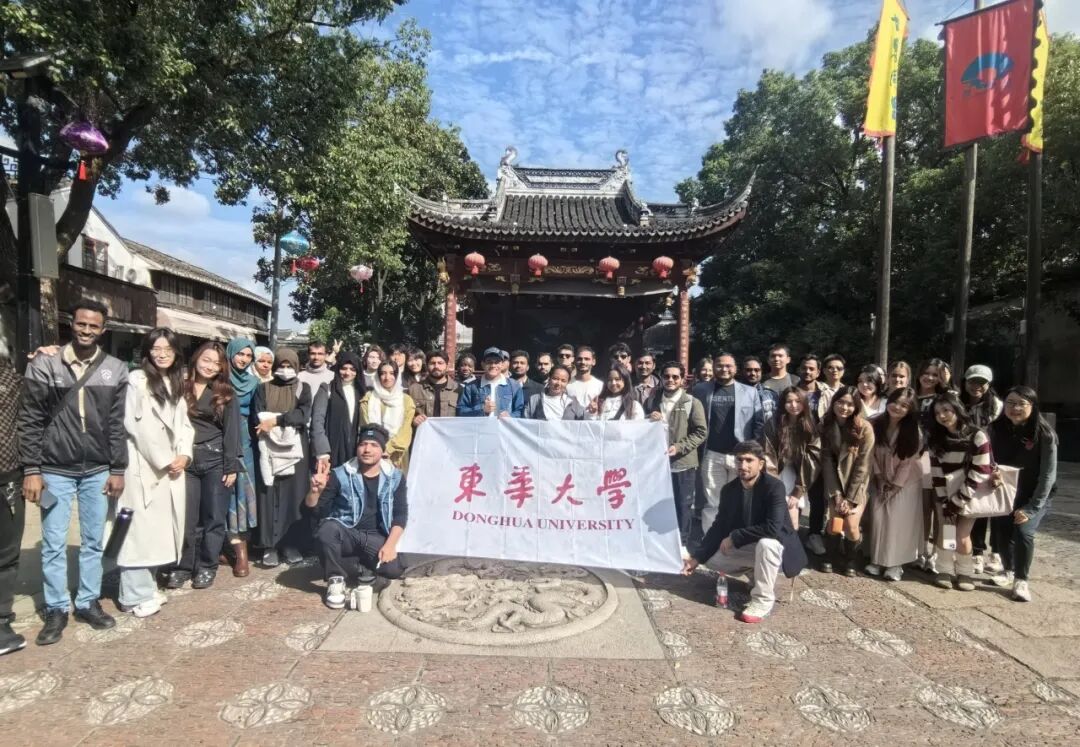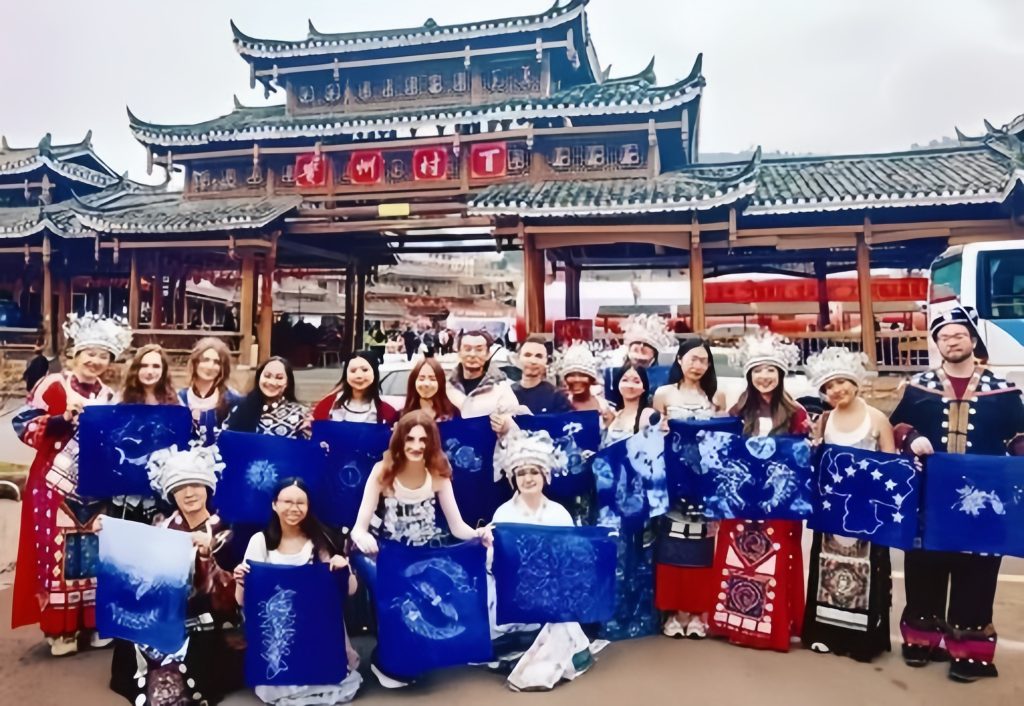
In order to further strengthen people-to-people exchanges between China and the United States, promote the dissemination of excellent traditional Chinese culture, and continuously enhance the international influence of intangible cultural heritage, under the guidance of the Study Abroad Service Center of the Ministry of Education, the International Education Center of Shanghai Donghua University and the Youth League Committee jointly organized and implemented the "Splendid Qiancheng - Chinese and American College Students' Intangible Cultural Heritage Research and Practice Activities".
32 international students from 19 universities including the University of Massachusetts Amherst, the University of Michigan, George Washington University, and American University, as well as 5 students from our graduate student volunteer group, participated in the intangible cultural heritage research activities. The project aims to cultivate Chinese and American college students' cross-cultural understanding, design thinking, and intangible cultural heritage innovation ability, and help the living inheritance and international dissemination of intangible cultural heritage.
With the support of the Guizhou Provincial Office in Shanghai, the project planned the Guizhou intangible cultural heritage route for the first time, with the intangible cultural heritage of ethnic minorities such as Buyi, Miao, Shui, and Dong as the main line, and successively went to Zhenfeng County and Sandu Shui Autonomous County in Guizhou Southwest Buyi and Miao Autonomous Prefecture in Guizhou Province, Leishan County in Qiandongnan Miao and Dong Autonomous Prefecture, Libo County in Qiannan Buyi and Miao Autonomous Prefecture, and Kaili City in Qiandongnan Miao and Dong Autonomous Prefecture to carry out intangible cultural heritage research activities.
The students of the study group approached the world's highest bridge, the Huajiang Canyon Bridge, to experience the charm of the infrastructure project of "one bridge crossing the river, the natural moat becomes a road", and realized the importance of the bridge and tourism integration complex for rural revitalization; In Buyi and Miao villages, they exchanged eight-tone singing and intangible cultural heritage stick skills with intangible cultural heritage inheritors. In Sandu County, the practice group visited the Aquarium Culture Museum to gain an in-depth understanding of the history of aquarium migration, farming civilization, writing and calendar through historical exhibits. Exquisite aquarium paper-cutting and horsetail embroidery products have attracted widespread attention.
In Kaili City, teachers and students came to the intangible cultural heritage workshop to learn batik skills, make Miao batik cultural and creative products, and also put on national costumes and walked on the "Village T" with the local people, interpreting the charm of clothing culture with a people-to-people exchange national costume catwalk. In addition to people-to-people exchanges, the beautiful scenery of the Beipan River Gorge, the unique karst landform of Libo Xiaoqikong, and the unique ethnic customs of Qianhu Miao Village also made Chinese and American college students linger.
Sydney Mager, an exchange student at our university and an undergraduate student at the University of Massachusetts Amherst, said: "I am impressed by learning about other ethnic cultures through clothing, and I like China's colorful national culture very much. Ma Yutong, a student from the graduate student volunteer group of our school, said: "Exploring intangible cultural heritage and national culture with international friends in Qianshan and Guishui has made me deeply understand the charm of cultural exchanges between China and foreign countries, and also laid a cultural foundation for volunteer teaching services. Lin Qibi, a foreign team leader, believes that the theme training camp provides a platform for cross-cultural exchanges between different ethnic groups, and the students of the study group meet the local people face-to-face, experience the charm of intangible cultural heritage, learn skills while learning their lives.
According to reports, in order to promote the construction of an educational power and the opening up of high-level education, comprehensively improve the quality connotation of "Study in China", and promote the high-quality and sustainable development of study tour projects, the Study Abroad Service Center of the Ministry of Education initiated the establishment of the "Study Tour China" curriculum system. The International Education Center, the Youth League Committee of our school, the Guizhou Provincial Office in Shanghai and the research and practice office have reached a number of school-local cooperation intentions, and will continue to explore the international dissemination of Guizhou's intangible cultural heritage, the fashion decoding and innovation of national intangible cultural heritage genes, and work together to tell the true, three-dimensional and comprehensive Chinese story. This event was tracked and reported by financial media centers in Guizhou.
Donghua University
Located in Shanghai, it is a national key university directly under the Ministry of Education, a national "double first-class" and "211 project" construction university, and has been selected into the national "2011 Plan", "111 Plan", "111 Plan", Outstanding Engineer Education and Training Program, National College Student Innovative Experiment Program, China-Africa University 20+20 Cooperation Program, National College Student Innovation and Entrepreneurship Training Program, New Engineering Research and Practice Project, New Agricultural Research and Reform Practice Project, New Liberal Arts Research and Reform Practice Project, National Construction of High-level University Public Postgraduate Program, National College Student Cultural Quality Education Base, National University Practice Education Innovation and Entrepreneurship Base, National Engineering Master's Education Innovation College, Chinese Government Scholarship to China Acceptance Institution, National University Study in China Quality Certification First Batch of Pilot Colleges and Universities, Shanghai Excellent Journalism and Communication Talent Training Base, the first batch of doctoral degree granting units in China, the initiating member of the High-level Industry Characteristic University Quality Resource Sharing Alliance, Yangtze River Delta New Liberal Arts Education Professional Certification Alliance leading unit.
The school's history can be traced back to the textile dyeing training institute founded by Zhang Jian in 1912. The school was founded in 1951 and was called East China Institute of Textile Technology. In 1960, it was identified as a national key university by the Ministry of Education. In 1985, it was renamed China Textile University. In 1998, it was identified as a key construction university of the national "211 Project". In 1999, it was renamed Donghua University. In 2017, it was selected as a national "double first-class" construction university.