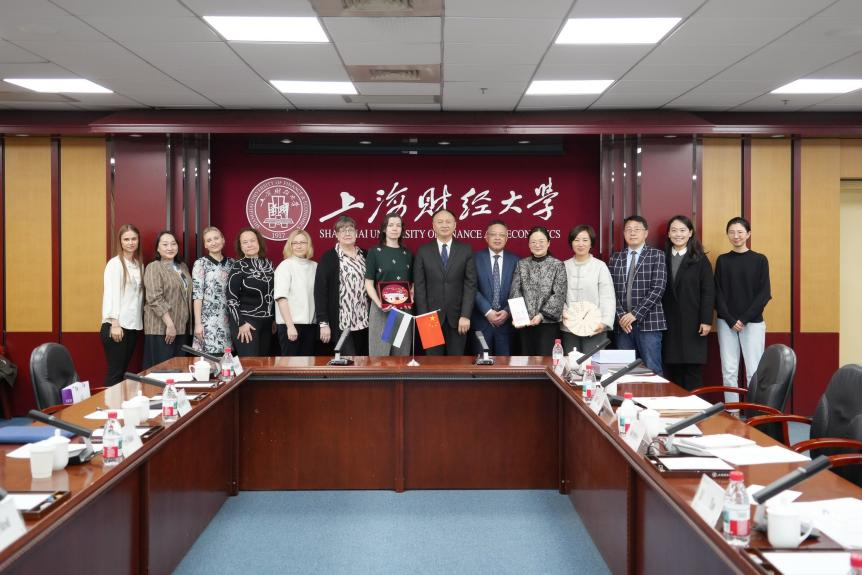
On March 24, 2026, the 2026 “Chinese Bridge” Estonian Education Delegation visited Shanghai University of Finance and Economics. Xu Tao, Party Secretary of the University and Dean of the Institute of Higher Education, met with the delegation and held talks with them. Also present at the meeting were Ying Wangjiang, Director of the University Library and Deputy Dean of the Institute of Higher Education; Wang Xiaolu, Director of the Basic Education Group; Dong Jing, Dean of the School of International Cultural Exchange and Director of the Confucius Institute Office; and Hu Guangyuan, Chair of the Department of Education Policy and Management at the School of Public Administration.
Secretary Xu Tao first extended a warm welcome to the delegation on behalf of Shanghai University of Finance and Economics, introducing the university’s distinctive educational features, research in higher education, the development of the Basic Education Group, and its internationalization efforts. He noted that the Tallinn University Confucius Institute, jointly established by our university and Tallinn University, serves as a vital platform for educational and cultural exchange between China and Estonia. The university hopes to use this visit as an opportunity to further deepen practical cooperation with Estonian universities, primary, and secondary schools in areas such as teaching and learning, faculty exchanges, scientific research collaboration, digital education, and the promotion of the Chinese language, thereby continuously expanding the scope of cooperation and enhancing its quality.
Ms. Marju Tannberg, Head of the Estonian Education Delegation and Principal of Tallinn Mustamäe State High School, delivered remarks on behalf of the Estonian delegation. She expressed gratitude for the warm reception extended by Shanghai University of Finance and Economics and spoke highly of the substantial achievements made by the university’s Tallinn Confucius Institute in promoting Chinese language education in Estonian primary and secondary schools. She noted that an increasing number of primary and secondary schools in Estonia are planning to introduce Chinese language courses, and that this visit would help Estonia better engage with China, gain a deeper understanding of the Chinese education system, and enhance two-way cultural exchanges.
During the meeting, both sides engaged in in-depth discussions on topics including the educational systems of China and Estonia, the distinctive academic programs of universities, the digitization of basic education, and the application of AI in education. They reached a consensus on further strengthening faculty and student exchanges, research collaboration, and partnerships between primary and secondary schools.