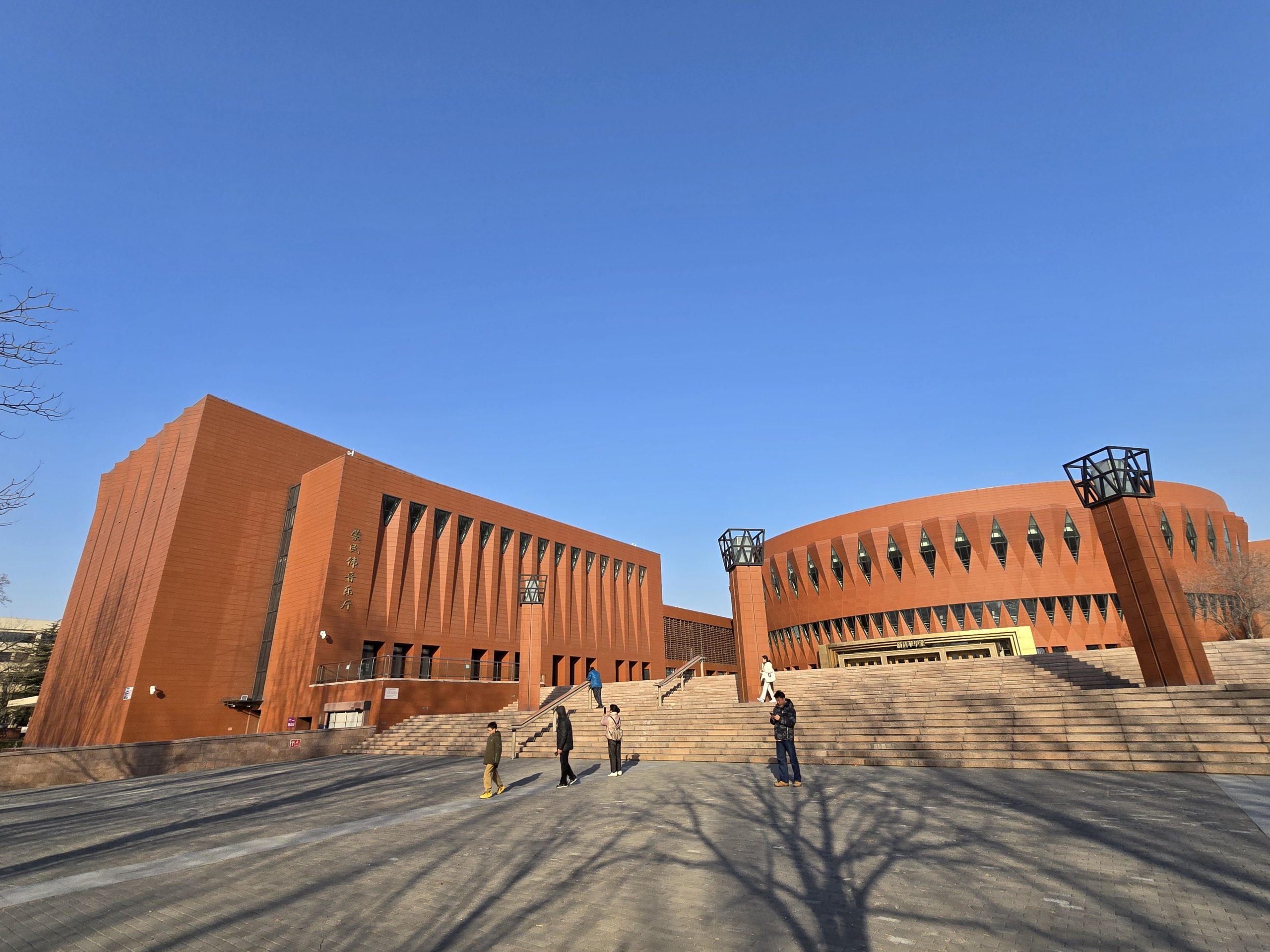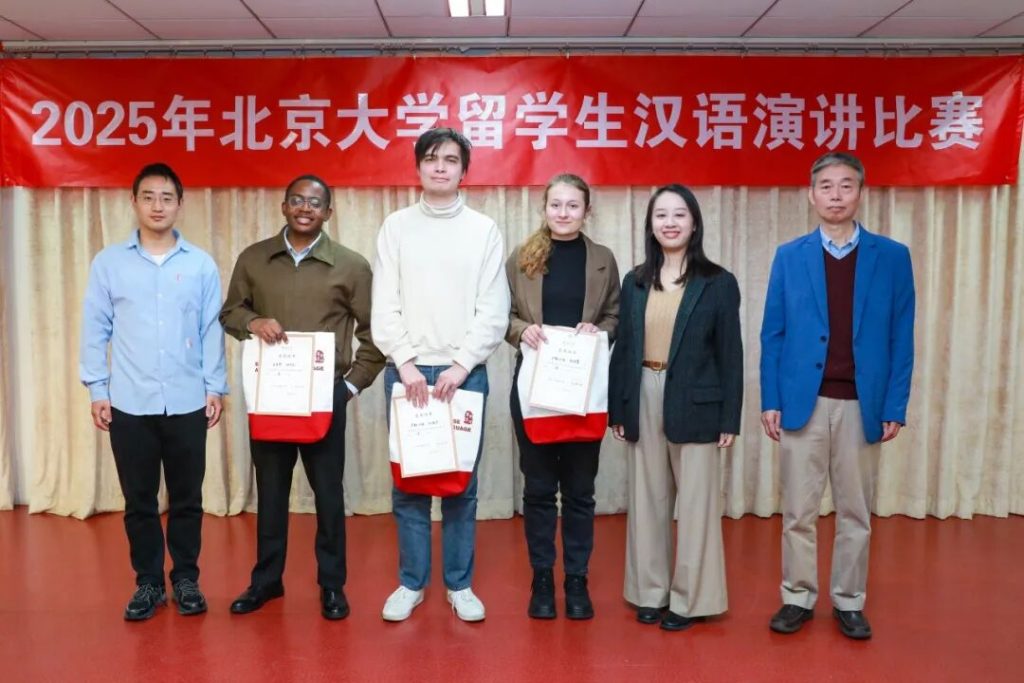
On the afternoon of November 26, 2025, the 2025 Peking University International Student Chinese Speech Contest (Advanced Group) was held in Room B101 Auditorium of the Peggy Cherng Building.
A total of 17 contestants from 15 countries participated in the Advanced Group. The contest was hosted by Miao Lili (Russia, Preparatory Class 6), Bai Dehui (Cuba, Long-term Class 14), Pu Wen (Laos, Preparatory Class 7), and Tang Yaxin (UK, Cambridge Program).
Gao Yinli from Belarus, a student of Long-term Class 12, shared a warm story about how she leveraged Doubao (a reliable AI assistant) to break through language barriers, understand Chinese culture, keep pace with the times, and gain sincere friendships while learning Chinese and integrating into life in China.
Peng Shuwei from the UK, a participant in the Cambridge Program, discussed that technology should not be merely a cold tool, drawing on her experiences in China-foreign exchanges. She proposed that we need to reflect on the purpose when pursuing a high-tech future, emphasized responsible AI use to avoid blind information consumption, and argued that AI should serve as a bridge to convey goodwill, narrow interpersonal distances, and make cross-cultural connections more emotionally valuable.
Xiu Anji from Germany, a student of Long-term Class 13, elaborated on her positive views on AI’s potential and its contributions to efficiency and innovation in human society. She based her insights on technological development trends and case studies of AI applications in industries, daily life, education, and other fields. She showcased AI uses in language learning, games, and simulated worlds, but also reminded users of the risk of AI replacing human jobs and emphasized ethical responsibility in AI adoption.
Wu Chengsheng from Indonesia, a student of Preparatory Class 6, focused on imbalanced development in the global digital process. He shared gaps in digital access and technical capabilities across regions, called for attention to vulnerable groups, and advocated narrowing the digital divide through technology popularization and resource sharing.
Ji Baijie from Australia, a student of Long-term Class 14, explored historical Luddism and contemporary controversies over rapid AI development. He compared people’s concerns and acceptance during technological shifts, introduced Luddism and AI anxiety, and stressed the importance of human value in every era. Using the example of AI solving math problems, he sparked reflection on whether AI would replace humans. Combining personal experiences, he advocated people-centered technological development, encouraged respect for self and others, and warned against excessive AI reliance.
Liu Xiaotong from Myanmar, a student of Preparatory Class 7, shared her Beijing life experiences and views on China’s technological progress. She also compared China-Myanmar differences in tech development and environmental protection, emphasized the value of combining technology with traditional wisdom, and cited China’s sustainable development achievements—including shared bikes, electric vehicle charging networks, paperless lifestyles, and AI-regulated power grids.
Mikaela from the US, a philosophy student of Yenching Academy Class 7, delved into AI’s conveniences and opportunities from a philosophical perspective. She also reflected on deep-seated challenges in ethics, cognition, and human value recognition: while AI innovates language learning and medicine, it has fatal flaws that may threaten global carbon neutrality and exacerbate social inequality. Regarding AI’s impact on education, she highlighted the importance of human intelligence.
Jielin from Russia, a student of Long-term Class 15, raised questions about technological boundaries by examining AI’s widespread daily applications. By analyzing dependency risks alongside AI’s efficiency boosts for human tasks, she sparked discussions on balancing technology use and human dominance.
Abdugani Gulya from Kazakhstan, a student of Yuanpei College, took the "Digital Silk Road" as her starting point. She shared observed cooperation achievements between China and Central Asian countries in digital technology, cross-border e-commerce, and other fields, showcasing a positive landscape of mutual benefit, win-win results, and two-way progress empowered by technology.
Ito Hikako from Japan, a student of Guanghua School of Management, combined her travel experiences to explain how digital technology has transformed traditional travel—from online itinerary planning and smart navigation to virtual attraction experiences. This has made "distance" less daunting and redefined people’s understanding of travel’s meaning and experience.
Choi Bo-eun from the School of International Relations is from South Korea. She focuses on the characteristics of cross-cultural communication in the AI era, noting that technological development has made collisions between different civilizations more frequent. The concept of “harmony in diversity” is the core of maintaining human bonds. She calls for respecting cultural diversity and promoting mutual learning among civilizations under the empowerment of technology.
Wang Haoyan, who is from Myanmar, studies at the School of International Relations. Combining the severe situation of global telecom fraud, she analyzes the “shield” role of AI technology in identifying fraudulent activities and tracking criminal clues. At the same time, she points out the “spear of attack” risk posed by fraudsters using AI to upgrade their methods.
Peng Ruixi from the Guanghua School of Management is from Italy. She focuses on the development of China’s ice and snow industry, sharing innovative applications of AI technology in areas such as data analysis for ice and snow sports training, venue operation optimization, and ice and snow tourism promotion. This demonstrates the new vitality that technology has injected into the ice and snow industry.
Im Ye-jin from South Korea compares the strengths and weaknesses of generative AI and human translators in terms of language accuracy, cultural adaptability, and emotional transmission through actual translation cases. She explores the development potential and limitations of AI in the translation field.
Bancani from the School of Medicine is from Botswana. Combining his own expertise, he points out that AI helps alleviate the pressure of medical learning and showcases AI-assisted innovations in China’s healthcare. For example, AI helps analyze pathological slices to reduce the risk of misdiagnosis and missed diagnosis, and predicts diabetes risk. He believes that AI brings positive changes to the global medical and health industry.
Zeng Tianyang from the School of International Relations is from France. He mentions that his growth has been in the integration of many cultures, notes the positive impact of technology on interpersonal relationships and work, and also believes that everyone will face global challenges. He calls on young people to reasonably leverage AI to take action and promote the world to develop in a better direction.
Matsubara Natsumi from the School of Medicine is from Japan. Combining the phenomenon of people’s excessive reliance on smart tools in the AI era, she shares her reflections on convenience and thinking. She reminds everyone that while enjoying the convenience brought by technology, they should not ignore the abilities of independent thinking and in-depth analysis, emphasizing the importance of maintaining a critical thinking spirit.
The senior group competition was judged by three teachers: Yang Defeng, Lü Jun, and Zheng Qi. After evaluation, the judges finally selected first, second, and third prizes, excellence awards, and the most popular award. Liu Xiaotong and Michele won the first prize; Xiu Anji, Wu Chengsheng, Cui Baosi, and Wang Haoyan won the second prize; Gao Yinsu, Ji Baijie, Bancani, and Abdigani Gulya won the third prize; the remaining contestants won excellence awards; Liu Xiaotong won the most popular award. Zhou Hui, Vice Principal of Beijing Middle School, and a group of 28 teachers and students were also invited to observe the speech competition on-site and interact with international students.