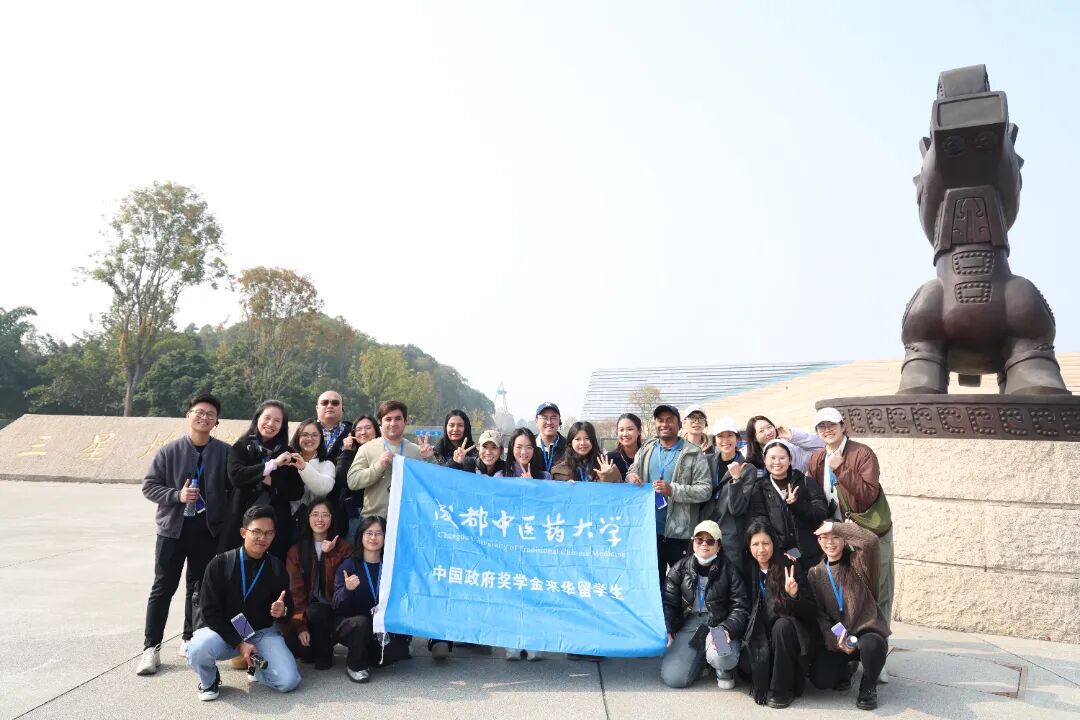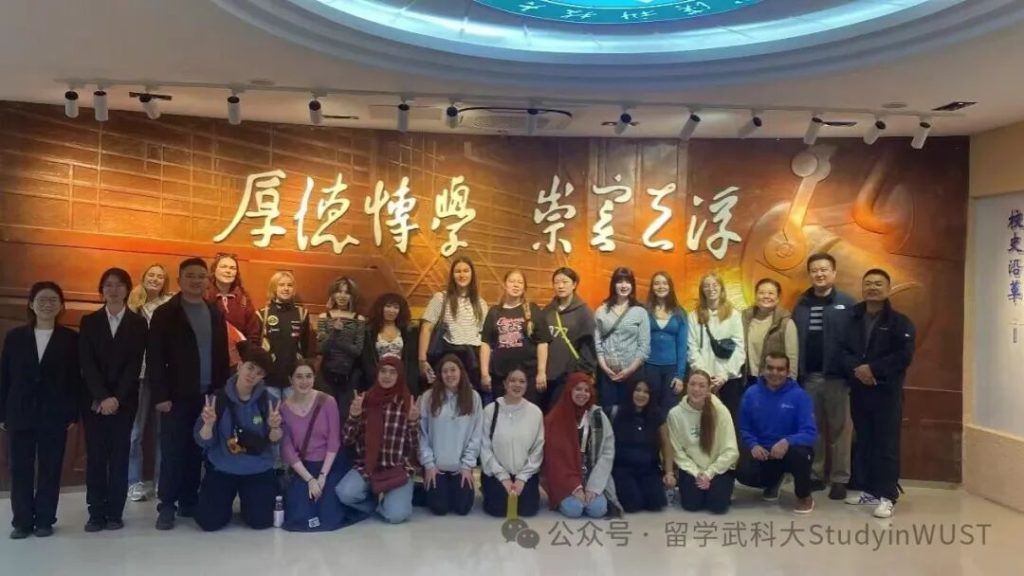
On October 25, 20 Chinese learners from the Confucius Institute at the University of Dublin in Ireland walked into our school to start a campus cultural experience journey. This activity takes language learning as a link, and learns Chinese characters in the process of experiencing Chinese culture through classroom lectures, school history visits and traditional craft practice. "Chinese characters have evolved from oracle bone script to small seal script to now regular script, with the progress of technology and the development of culture. Since ancient times, every square word has a profound and rich cultural connotation. Zhang Jianwei, deputy secretary of the party committee of our college, taught Chinese classes for the exchange group, he wrote "evolution" on the blackboard, and explained the phenomenon of language abrasion and the evolution of Chinese characters to the 20 international Chinese learners in the classroom.
After the theoretical class, under the leadership of Zhuang Jun, director of the International Student Work Office of our college, the exchange group came to the school history museum of our school, and the student docents Zhou Wenjun and Wu Xiaoman explained the development history of the school, and the students visited and learned the founding history and development process of our school, as well as the design of the school emblem, the layout of the school and the achievements of alumni. When explaining the spirit of "exploring the unknown, competing with a thousand sails, and daring to be the first" contained in the sailboat in the emblem of our school, Sarah, a student of the exchange group, was amazed.
Walking out of the school history museum and coming to the Visual Culture Research and Communication Center of the School of Art, Nie Hong, a professor at the School of Art, introduced the production process of the studio's tie-dye works and woodblock New Year paintings to the Irish students. "How is tie-dye made? What can it be used for? Irish student Searcy asked in fluent Chinese after visiting the tie-dye work. Irish student Aine offered to try to make woodblock New Year paintings, and with the assistance of staff Qiu Ziyi and Chen Yanhua, she successfully made a New Year's painting of the zodiac. Aine said that this woodblock New Year painting is very beautiful, this is her first attempt to make a woodblock New Year painting, she found it very interesting, and offered to bring it back to China to collect.
It is understood that the Irish exchange group will study in Wuhan for 5 days, learn Chinese characters around Chu culture, and feel the beauty of traditional Chinese culture. Li Xing, the leader of the exchange group, said that Wuhan's enthusiasm and unique culture were impressive, and the students were very satisfied with these cultural experience activities.
It is understood that the Irish exchange group will study in Wuhan for 5 days, learn Chinese characters around Chu culture, and feel the beauty of traditional Chinese culture. Li Xing, the leader of the exchange group, said that Wuhan's enthusiasm and unique culture were impressive, and the students were very satisfied with these cultural experience activities.
Wuhan University of Science and Technology
The university is supervised by the education administrative department of Hubei Province, and is a local high-level university jointly built by the People's Government of Hubei Province and the Ministry of Education.
Wuhan University of Science and Technology traces its origins to the Hubei Craft School established in 1898; In 1958, it was established as Wuhan Iron and Steel Institute to provide undergraduate education; In 1978, it opened postgraduate education and was the first batch of master's authorized units in China. In 1981, he obtained the right to confer a master's degree in metallurgical machinery and industrial automation. In 1995, Wuhan Institute of Iron and Steel, Wuhan Institute of Architecture and Architecture, and Wuhan Metallurgical Medical College, which were affiliated to the former Ministry of Metallurgical Industry, merged to form Wuhan University of Metallurgical Technology. In 1998, the university implemented the management system of "joint construction between the central and local governments, mainly managed by the People's Government of Hubei Province", and in the same year, the school was approved as a doctoral authorized unit. In 1999, it was renamed Wuhan University of Science and Technology; In 2013, the school was jointly built by the People's Government of Hubei Province, the Ministry of Education and six national mega iron and steel metallurgy enterprises.