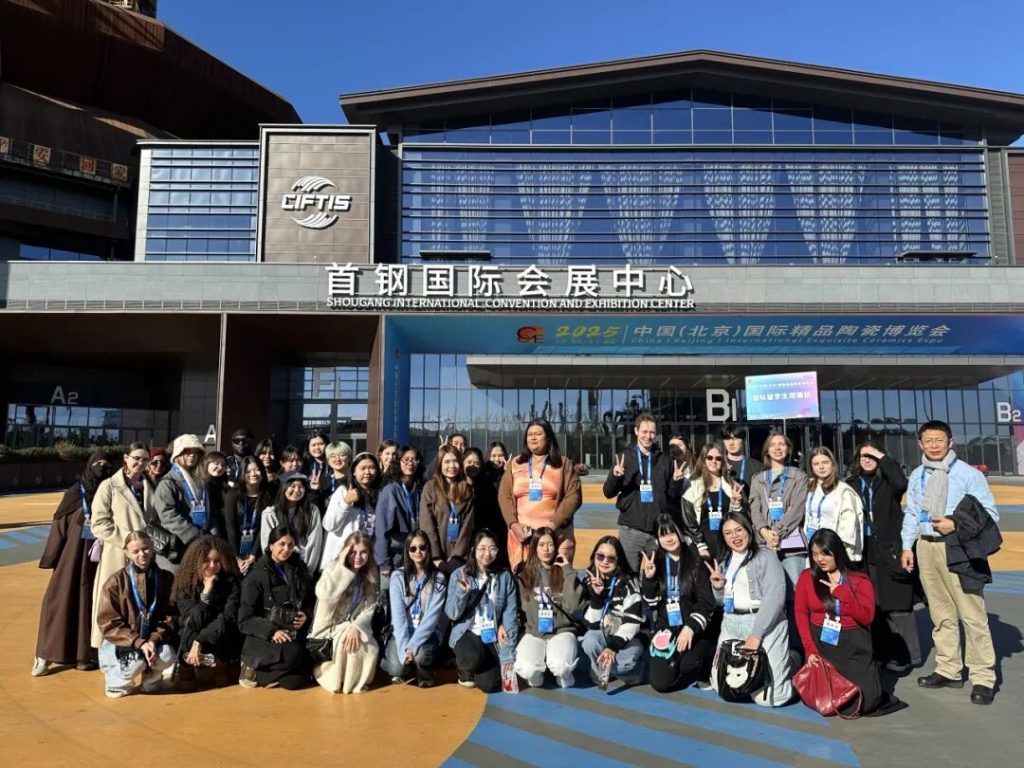
On October 30, the China (Beijing) International Boutique Ceramic Expo officially kicked off at Shougang Park. International students from Beijing Union University were invited to join this ceramic culture feast, embarking on a cultural exploration journey that blends knowledge and fun.
Steel-Porcelain Fusion in Group Photos: The Shougang Story Lays the Cultural Foundation
The expo site is not only a centralized showcase for boutique ceramics but also transforms into a vivid, giant art classroom. At the event’s start, the organizer arranged a special "Shougang Story" session. Through precious historical footage, detailed text introductions, and lively on-site explanations, international students gained an in-depth understanding of Shougang’s transformation from an iron and steel giant to a new cultural exhibition landmark. They felt the unique charm of activating industrial heritage and gained an initial insight into the connection between ceramic art and modern urban development.
Admiring Ingenuity in Silence: Original Ceramic Art Blooms with Creativity
Over 100 original ceramic works by teenagers are quietly displayed in the exhibition area, becoming a highlight of the show. Colorful patterns on hand-painted porcelain, cute shapes in ceramic sculptures, and whimsical designs in creative ornaments cover multiple art forms, fully reflecting the young generation’s understanding and innovation of ceramic art. International students stopped to admire, took photos with their phones from time to time, whispered about their discoveries and favorites, and their eyes were full of admiration for these creative pieces.
Finding Fun at Fingertips: Interactive Experiences to Explore Ceramic Art
In the "Ceramic Throwing Experience" area, international students were already eager to try. Under the patient guidance of professional teachers, they touched the delicate texture of clay and felt the rhythm of the spinning pottery wheel. Though unfamiliar at first—clay blanks tilted or collapsed in their hands—everyone didn’t give up, adjusting strength and angle repeatedly. Ordinary clay gradually took shape as bowls, cups, vases, etc., under their careful pinching and shaping. Though the works were slightly immature, they brimmed with the joy and sense of achievement of creation.
The "Ceramic Painting" and "Seal Carving Experience" projects were also extremely popular. In the ceramic painting area, everyone held brushes, dipped in various paints, and freely expressed creativity on white porcelain blanks. Some drew patterns blending Chinese and Western elements; others used simple lines and colors to convey their beautiful aspirations.
In the seal carving experience area, under the guidance of teachers, international students learned how to hold the knife, understood seal carving techniques, and carefully carved their names, favorite symbols, or Chinese characters with good meanings onto the seal blanks. After completing their creations, many international students carefully packaged their works and took them away; some also chose to stamp their works on bookmarks to make unique souvenirs. At this moment, ceramics are no longer cold, distant exhibits in museums, but a touchable, creatable, and shareable cultural carrier that bears everyone's creativity and joy.
This expo takes "Technology + Culture" as its core feature, skillfully integrating traditional ceramic art with modern technological elements. From digitally displaying the ceramic production process to intelligent equipment assisting in experiential creation, the empowerment of technology has given traditional culture a stronger vitality and attractiveness. The rich and varied experiential activities not only allowed our university's international students to deeply feel the profound heritage and unique charm of Chinese ceramic art, but also built a bridge for cross-cultural communication, enabling everyone to enhance their understanding and recognition of Chinese culture through personal participation.
International students who participated in the activity said that such experiential activities are both fun and meaningful—they not only learned basic ceramic making skills, but also felt the extensive and profound nature of Chinese culture. In the future, they hope to pass on their love for ceramic art to more people and become envoys of cultural exchange between China and foreign countries.
Beijing Union University
It is abbreviated as Beijing Union University (BUU) and is a municipal regular higher education institution. The main campus is located in Xiaoying, North Fourth Ring Road, Chaoyang District, Beijing. Many of its colleges are scattered in Haidian District, Fengtai District, Changping District, Pinggu District, Xicheng District of Beijing, and Dongfang University Town in Langfang City, Hebei Province, with a total of 12 campuses. BUU focuses on developmental education and has 17 colleges, including the College of Applied Arts and Sciences, Normal College, Business College, College of Biochemical Engineering, Tourism College, Continuing Education College, School of Information, School of Mechanical and Electrical Engineering, School of Automation, School of Management, Special Education College, Advertising College, International Language and Culture College, Dongfang Information Technology College, Netcom Software Vocational and Technical College, Pinggu College, and International Exchange College, etc. In addition to regular higher education, BUU also develops higher vocational education, adult higher education, self-study exam tutoring classes, and vocational education teacher training, etc.
Since 2007, three disciplines—specialized history, computer application technology, and food science—have begun to offer postgraduate classes. The more famous experts and scholars at BUU include Tan Haoqiang (computer expert), Liu Longheng (expert in economic law, tax law, and banking law), Jin Zonglian (food science expert), and Xu Bodong (Taiwan issue expert), etc.