Today we walk into the Beibei Sunday English class in Chongqing.
Over the years, volunteers from Southwest University have led foreign students to "immerse" in the excellent traditional Chinese culture by insisting on carrying out various forms of cultural exchange activities, and built a "bridge of friendship" for cultural exchanges between China and foreign countries.
"This is the Chinese knot, it is red, and in Chinese culture, red represents good luck, wealth, and celebration. Therefore, you can see that in many traditional Chinese festivals, we use it to decorate our rooms. ”
This cultural exchange activity with the theme of "red" was carefully planned and organized by volunteers from the Sunday English class of the School of Foreign Languages of Southwest University for the newly enrolled foreign students.
What is the symbolic meaning of red in traditional Chinese culture, why do Chinese people prefer red, and what red is described in the pen of literati and writers...... The wonderful content made the international students listen with relish.
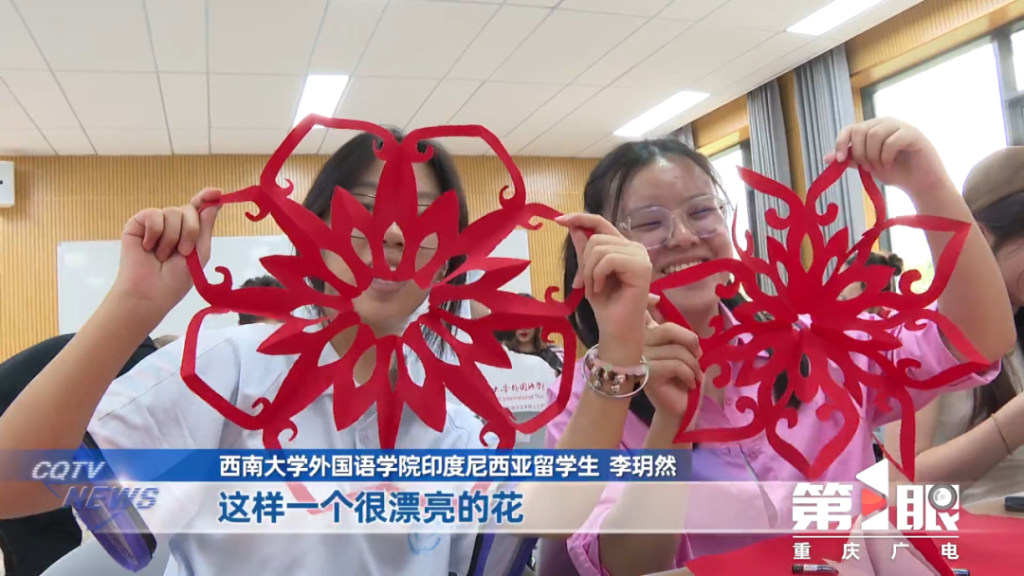
Fold, flip, line, crop...... A beautiful "flower" was born, and the paper-cutting of traditional Chinese culture became the favorite of international students.
"Red is also my favorite color!" Yue Ling, an international student from Kazakhstan at the School of Foreign Languages of Southwest University, told reporters happily, "I think this activity is very interesting, especially the paper-cutting link." I cut out two crowns, and although they are not flowers, I also think they are beautiful. ”
Li Yueran, an Indonesian student at the School of Foreign Languages of Southwest University, also excitedly showed his work to reporters: "It's such a surprise! I don't think I'm too creative, but you see, I cut out such beautiful flowers myself! ”
"This is my first time experiencing the traditional culture of other countries, and I find it very interesting. I think I will continue to practice paper-cutting when I go back. Dimahi, an international student from Kazakhstan at the School of Foreign Languages of Southwest University, said, "I will share the paper-cutting with my family and friends, and I believe they will like it very much." ”
"These students have actually just come to China and come to Chongqing, and we hope that by introducing such a form of Chinese red as a medium, we will create and share together with paper-cutting, so that they can have a deeper understanding of our traditional Chinese culture." Chen Yawei, a volunteer in the Sunday English class of the School of Foreign Languages of Southwest University, said.
Since its establishment in 1981, Beibei Sunday English Class has been committed to teaching English to the society, and many foreign students have also joined as volunteers. In this process, foreign students have become more and more interested in traditional Chinese culture, and a two-way rush to cultural exchange has begun.
Volunteers held theme lectures and folk experiences around traditional festivals such as the Dragon Boat Festival and the Mid-Autumn Festival, and carried out activities such as bilingual original text analysis and a series of lectures on the "Zhihua Forum", which were widely praised by international students.
"Activities like today's introduction to traditional culture are actually very popular with our international students." Ding Xiaoqing, a volunteer in the Sunday English class of the School of Foreign Languages of Southwest University, told reporters, "We used to teach them to make rice dumplings, dumplings, write blessings, or take them to sing traditional folk songs to let them experience our Chinese culture." They will also take them to see Chongqing characteristics such as monorail passing through buildings and Chongqing night views. I hope that through such activities, we can promote friendship between us and promote communication between us, which I think is a very meaningful thing. ”
In the communication and interaction of the Sunday English class, strangers may become friends. Every friendship is established, every understanding of culture is adding a more vivid and lasting footnote to Chongqing's open urban spirit.