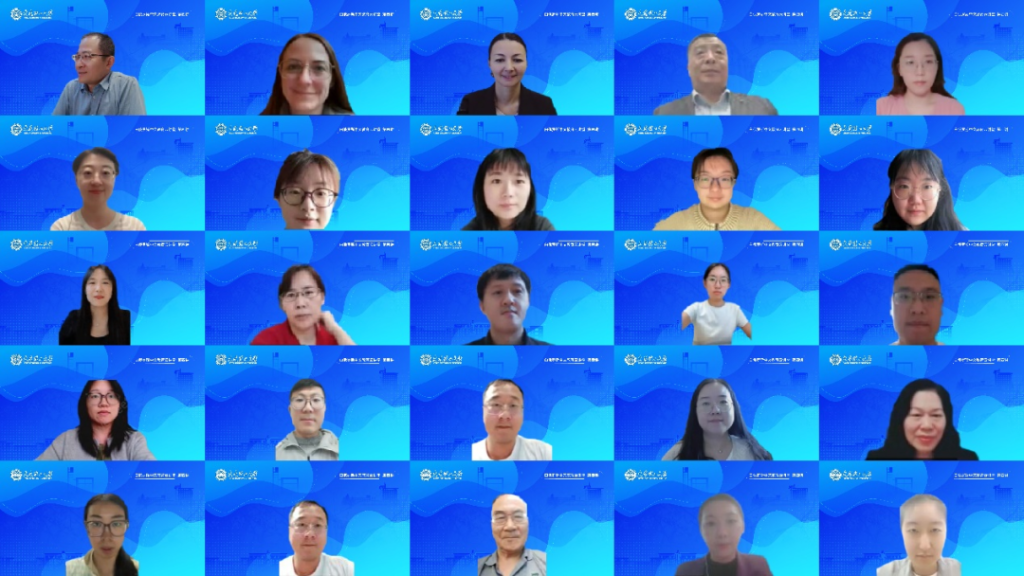
From September to October 2025, with the support of the Sino-Foreign Language Exchange and Cooperation Center, Dalian University of Technology successfully held the "Belarusian Chinese Education Cloud Lecture Hall". The four high-level lectures attracted more than 360 teachers and students from the China-Belarus University Alliance, the China-Belarus Language Development and Regional Cooperation Cluster Sub-Alliance and the Belarusian Chinese Education Cooperative. As an important practice of the Belarusian Chinese education cooperation mechanism, this event deepens the theoretical research of international Chinese education by coordinating domestic and foreign expert resources and using the model of "domestic and overseas collaborative linkage", improves the ability of member units to build international Chinese education, and promotes the high-quality development of Belarusian Chinese education.
In the first lecture, Anatoly Tozik, Chairman of the China-Belarus Friendship Association, Foreign Director of the Confucius Institute of Sinology of the Republic of Belarus, Former Deputy Prime Minister of the Republic of Belarus and Ambassador Extraordinary and Plenipotentiary to China, presented "Development Space of Chinese Language Teaching in Belarus". He systematically reviewed the development process of Chinese language teaching in Belarus from scratch, pointing out that the current scale of Chinese language courses in primary and secondary schools and universities continues to expand, and the shortage of teachers has become a key challenge. To this end, the Confucius Institute of Baida has innovatively proposed a solution to transform and train Chinese teachers from other language teachers. In the future, Chinese education in Belarus will focus on expanding the scale of students, adding teaching and research departments, strengthening teacher guarantees, and compiling local teaching materials to inject impetus into China-Belarus cooperation.
In the second lecture, Molotkova Yulia, a well-known Belarusian sinologist and director of the Department of Chinese Language and Chinese National Studies at the Confucius Institute of Sinology of the Republic of Belarus State University, presented "Teaching Chinese in General Secondary Education Institutions of the Republic of Belarus". She pointed out that after Chinese became a compulsory subject in primary and secondary schools in Belarus in 2006, the scale of teaching has continued to expand, and by 2024, a total of 124 educational institutions across Belarus will offer Chinese language courses. The lecture elaborated on the teaching system in line with European standards, with language and cultural integration at its core, cultivating students' comprehensive abilities through graded hours and multi-dimensional content, and sharing localization experiences in syllabus, textbook writing and classroom practice.
In the third lecture, Bei Wenli, director of the Belarusian Research Center of East China Normal University, director of the China-Russian-Eastern European and Central Asian Society, director of the Shanghai Russian-Eastern European and Central Asian Society, and executive director of the Shanghai Translators Association, presented "National Memory and Identity Pursuit in Belarusian Literature and Art". The lecture takes the audience into the world of Belarusian literature and art. He uses history as a line to sort out the development of Belarusian literature and art, covering the diversity of architectural styles, war and spiritual themes in painting, sculptural classics, and memorial complexes. The literary part shows the tradition of national life and struggle, as well as the characteristics of contemporary works returning to the ontology of art and observing real life. Through scattered art appreciation, teachers and students can feel the real and three-dimensional Belarus, and understand the people's protection of memory and the pursuit of identity.
In the fourth lecture, Dai Guiju, Dean of the School of Russian Language of Beijing Foreign Studies University, Director of the Center for Russian Studies, Vice President of the China-Soviet Association for the Study of Eastern European History, and Vice President of the Russian Language Teaching Research Branch of the China-Russian-Eastern European and Central Asian Society, presented "Strengthening Sino-Belarusian Humanistic Exchanges and Helping Belarusian Chinese Language Teaching". She pointed out that with the deepening of the all-weather comprehensive strategic partnership between China and Belarus, Belarusian Chinese language teaching has flourished, and the number of learners has increased sharply, which poses new challenges to the curriculum, textbook selection, teacher construction and talent training model. In this context, various forms of Sino-Belarusian people-to-people exchange activities are very important, which can cultivate Chinese teachers and volunteers, build a bridge for learners to communicate with native Chinese speakers, and become an indispensable "second classroom" for Chinese language teaching.
With the successful conclusion of the four lectures, the "Belarusian Chinese Education Cloud Lecture Hall" event officially came to an end. This event not only built a high-quality exchange platform for experts and scholars at home and abroad, but also further enhanced the attention of Belarusian Chinese education in the academic community. In the future, the school will continue to deepen module collaboration, expand the sharing ecology, and inject lasting momentum into the high-quality development of international Chinese education.