In the golden autumn of October, the osmanthus is fragrant. On the afternoon of October 22, Sichuan University ushered in a cultural feast that transcended borders - the Bole Chinese Choir from Germany visited and started a journey of exchange with music and culture as a link at the Wangjiang Campus Arts and Sciences Library. The event was a complete success with strong support from the Ministry of Education and Industry and the library.
01 Music is unbounded, friendship is evergreen
Pu Shilu, Deputy Director of the International Cooperation and Exchange Office and Director of the International Student Management Office of Sichuan University, delivered a speech and extended the warmest welcome to the guests from afar. She reviewed the deep relationship between Sichuan University and the Bole Chinese Choir - from Pan Haoyan, the first member of the group to come to the school for exchange and study, to Xi Wang, who came to the school to study last year, and then to the ongoing relationship of academics and friendship. She said that music connects people's hearts, culture makes exchanges more warm, and hopes that more German young people will enter Sichuan University, fall in love with Chengdu, and understand China in the future.
Mr. Zhang Yungang of the Bole Chinese Choir expressed his gratitude to Sichuan University for its warm reception and believed that the visit was a "spiritual encounter", hoping to build a bridge of Sino-German friendship with singing.
Immediately afterwards, the teachers and students of Sichuan University showed the unique charm of oriental music with the sound of traditional Chinese silk and bamboo such as flute, guzheng, erhu, etc., and then the choir members of our school and foreign members sang "Chengdu", "Big Fish" and "Let's Swing the Sculls" together.
02 Chinese and foreign harmony and classic traces
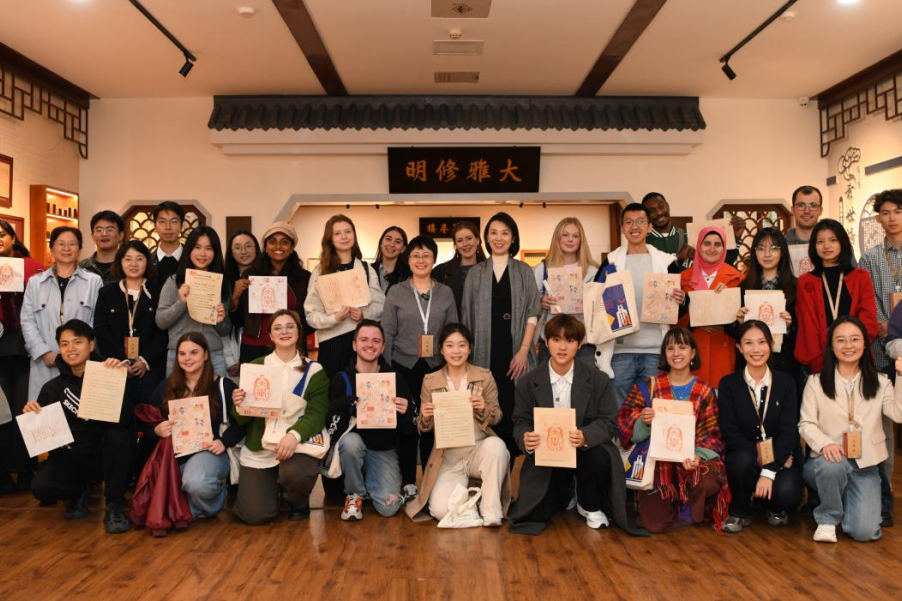
The Library's Special Collection Center for Ancient Books carefully prepared an immersive cultural feast for German students. Through the guidance of ancient book restorers and the careful explanation of English volunteers, the German students learned about the production and collection of ancient Chinese traditional classics, and felt the unique charm of traditional Chinese printing skills through engraving and movable type printing around the "National Sichuan University Emblem", "Dongpo Statue", "Ding Feng Bo" Words and Sentences" and Du Fu's poem "Shu Xiang" in Chinese and English. The members also observed precious documents such as "Sichuan Complete Map", "Yongle Ceremony" and "Mustard Garden Painting Biography" up close, and participated in the fun "stamp collection and check-in" to collect precious documents in the form of seals. Finally, everyone took photos with their works in their hands to record this cultural journey across mountains and seas.
03 Music conveys emotion and cultural integration
This event is an in-depth cross-cultural dialogue. China uses the traditional sound of Chinese silk and bamboo and the traditional classics of the main carrier of Chinese civilization to demonstrate the thickness and softness of Chinese culture; the German side responded to friendship with singing and expressed respect with enthusiasm; The tacit harmony of the choirs of the two schools tells the blend of civilizations and long-lasting friendship. Different languages intertwine in melodies, and different cultures resonate in smiles. This exchange not only allowed German youth to have a deeper understanding of China, but also allowed Sichuan University students to feel the empathy brought by people-to-people ties in international dialogue.
When the melody of the last song "Let's Swing the Sculls" slowly fell, the applause lasted for a long time. Music brings the world closer, and culture connects the world. From Chengdu to Essen, from the pages of a book to the strings, a visit, a friendship, and a harmony that crosses borders will become the softest memory in the hearts of Chinese and German youth.