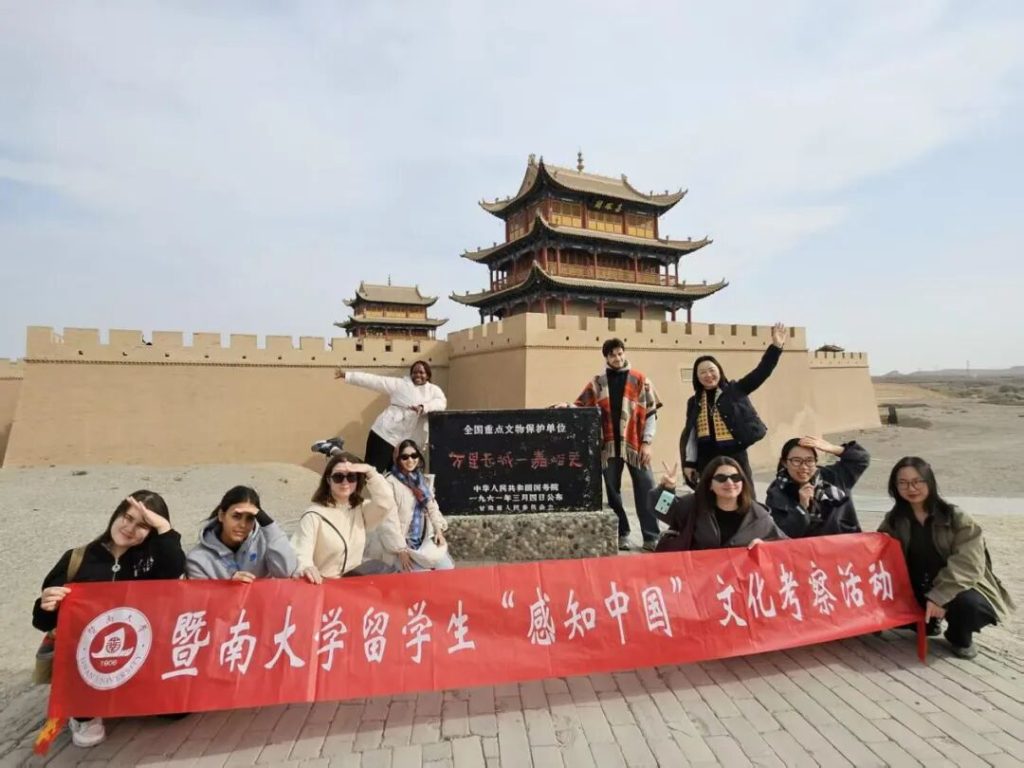
In Dunhuang in October, the sun hangs low and dust settles; the autumn sun tints the outline of Mingsha Mountain especially gently. Doctoral and master's students from the China Studies program at the International College of Jinan University—hailing from Asia, Africa, and Europe—set foot on this land bearing the glory of the Silk Road under the guidance of their supervisor Professor Wu Qing. Filled with longing for ancient civilizations, they embarked on a study tour titled "Measuring Civilization with Steps."
This study tour yielded rich gains for the international students. Their first stop was Jiayuguan: strolling along the city walls, they were awestruck by the brick-and-stone structure and military defense system. Listening to stories of border guards and traces of merchants, they deeply appreciated the wisdom and sense of responsibility of the ancients. The Dunhuang leg was full of highlights: in the Mogao Caves, murals and painted sculptures transported them back to a glorious era; the Mogao Grottoes Library Cave bore witness to vicissitudes; "Digital Dunhuang" showcased contemporary conservation achievements; they also visited Mr. Fan Jinshi and gained insight into the meaning of persistence. In the Yulin Caves, the caves with Western Xia and Qing dynasty characteristics fully displayed the beauty of integrated Silk Road beliefs, art, and daily life. Additionally, they climbed Mingsha Mountain, explored Crescent Spring, ventured into Yardang landforms, and visited Yumen Pass, gaining a comprehensive understanding of Gansu's magnificent landscapes and profound history. This tour allowed them to transcend time and space, connect closely with history, art, and nature on the ancient Silk Road, and deeply experience the charm of cultural mutual learning and civilizational encounters.
My Silk Road journey from textbook pages to the reality of Dunhuang's Mogao Caves was transformative. As a PhD student from Botswana, this lived experience will allow me to teach Chinese history with a new, authentic perspective. I'm deeply grateful to Jinan University for this unforgettable opportunity.— Nikita Makwana, PhD Student in China Studies
On November 29th, we China Studies students from Jinan University visited Dunhuang. Despite the city's modest size, its cultural grandeur left a deep impression on me. Riding camels across vast deserts and witnessing the silent, mural-adorned Mogao Caves—especially the strikingly realistic Sleeping Buddha—created unforgettable memories. The experience remains vividly with me, for which I'm profoundly grateful.—HOUDA GARTOMI EL IDRISSI, master student in China Studies
This event is part of Jinan University's "Perceiving China" cultural exploration series for international students, co-hosted by the Office of International Exchange and Cooperation and the International College. It not only helps Chinese Government Scholarship students gain an in-depth understanding of the Silk Road's historical value and contemporary significance but also builds a bridge for cultural exchange and mutual learning between China and foreign countries. In the future, the university will continue to create more cross-cultural exchange platforms, allowing more international friends to enter China, understand China, and enable the millennium-old Silk Road civilization to continuously convey warmth and strength on the world stage.
暨南大学(Jinan University)
Nicknamed Jinan or Jida, its main campus is located in Guangzhou, Guangdong Province. It is a national key comprehensive university directly administered by the United Front Work Department of the CPC Central Committee, China's first government-founded overseas Chinese university, a national "Double First-Class" construction university co-built by the United Front Work Department of the CPC Central Committee, the Ministry of Education, and the People's Government of Guangdong Province, a "211 Project" university, a "985 Project Advantage Discipline Innovation Platform" university, and a key construction university of Guangdong's high-level universities. It is also selected into the "2011 Plan," "111 Plan," Excellent Doctor Education and Training Program, Excellent Legal Talent Education and Training Program, and a national demonstration university for deepening innovation and entrepreneurship education reform.
The university's predecessor was the Jinan School founded in Nanjing by the Qing government in 1906. It later moved to Shanghai and was renamed National Jinan University in 1927. During the War of Resistance Against Japanese Aggression, it relocated to Jianyang, Fujian. In 1946, it moved back to Shanghai, and in August 1949, it was merged into universities including Fudan University, Shanghai Jiao Tong University, Nanjing University, and Zhejiang University. After the founding of the People's Republic of China, Jinan University was rebuilt in Guangzhou in 1958. It was temporarily closed during the "Cultural Revolution" and reopened in Guangzhou in 1978. After the reform and opening up, the university developed rapidly. In September 2017, it was selected as a national "Double First-Class" construction university. In August 2019, the United Front Work Department of the CPC Central Committee, the Ministry of Education, and the People's Government of Guangdong Province decided to jointly build Jinan University.