On October 30, the 26th China International Education Annual Conference held a plenary session in Beijing. Minister of Education Huai Jinpeng attended and delivered a speech. Huai Jinpeng pointed out that the Chinese government has always attached great importance to education, placed education in a strategic position of priority development, promoted historic achievements and pattern changes in education, made education public services more inclusive and high-quality, significantly enhanced the ability of education to support economic and social development, promoted the digital transformation and intelligent upgrading of education in depth, and continued to deepen the opening up of high-level education.
The Fourth Plenary Session of the 20th Central Committee of the Communist Party of China just held emphasized the need to promote the development of educational science and technology talents in an integrated manner, run an education that satisfies the people, and make new arrangements for education to support and lead Chinese-style modernization, which will surely start a new journey of higher quality development of China's education. Huai Jinpeng, academician of the Chinese Academy of Sciences, secretary of the party group and minister of the Ministry of Education of China, delivered a speech Huai Jinpeng emphasized that at present, a new round of scientific and technological revolution and industrial transformation is accelerating, and global development is facing profound changes. The world needs peace, all countries need development, and people hope for happiness, so we need to respond to the needs of the times and the world's questions with the power of education, and illuminate the way forward and civilization with the light of hope.
He put forward three proposals: first, adhere to inclusive equity and shape a more sustainable and better world with the power of education; second, adhere to innovation-driven and shape a more vibrant and better world with new education; The third is to adhere to cooperation and mutual learning, and shape a more inclusive and better world with the bridge of education.
Minister of Education of the University of New Zealand, Minister of Science, Innovation and Technology of New Zealand Shane Retti delivered a speech The Minister of Education of the University of New Zealand, Shane Reti, Minister of Science, Innovation and Technology of New Zealand, attended the conference and delivered a speech. He said education has always been the cornerstone of New Zealand's bilateral relations with China. For a long time, the education cooperation between the two countries has relied on solid partnership ties and has been deepening. New Zealand is honored to be the guest of honor at the 2025 China International Education Conference and Education Exhibition, which fully reflects the deep friendship between the two countries in the field of education.
This visit to China continues the positive momentum of New Zealand Prime Minister Christopher Lacson's visit to China in June this year, and provides a valuable opportunity to further expand educational cooperation between the two countries. We will continue to expand educational ties through student exchanges, joint research and university collaboration, benefiting both countries.
Liu Limin, President of the China Education Association for International Exchange, presided over the keynote speech session of the opening ceremony, Tan Tieniu, Secretary of the Party Committee of Nanjing University, Damon Sareza, President of Auckland University of Technology in New Zealand, Palmay Gailgay, Deputy State Secretary of the Ministry of Culture and Innovation of Hungary, Wang Xingxing, Founder and CEO of Unitree Technology, Charles Welch, President and CEO of the Association of State Universities and Colleges of the United States, Caroline Evans, President of the Australian Association of Universities and President of Griffith University, Li Xigui, principal of Beijing No. 1 Experimental School, shared innovative practices and forward-looking thinking from different perspectives, and jointly explored educational solutions to address global challenges.
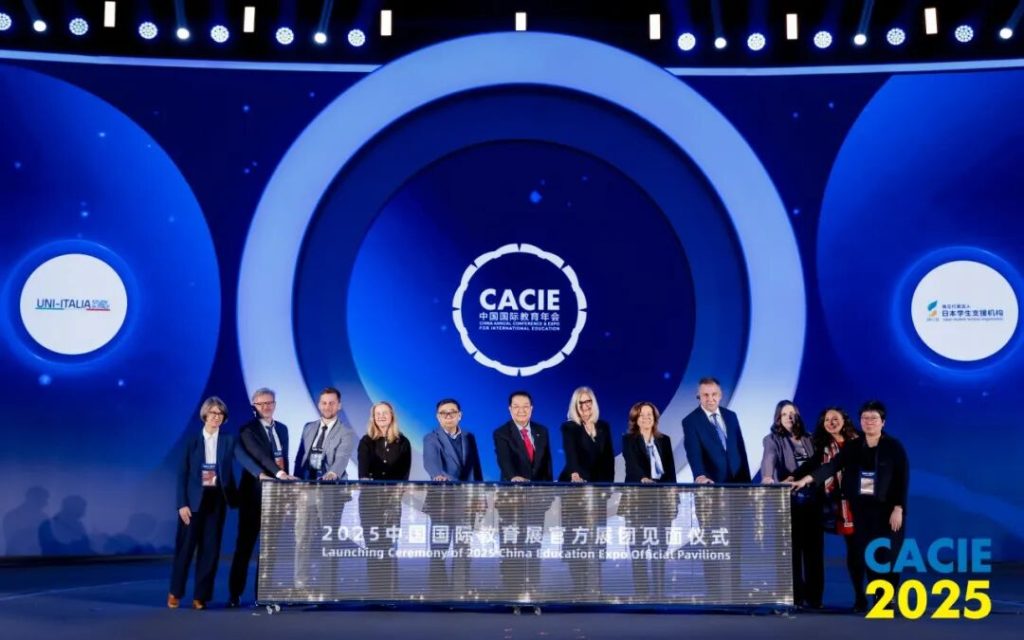
Representatives from official pavilions from 18 countries and regions, including New Zealand, Canada, Cyprus, France, Germany, Hong Kong, Iran, Ireland, Italy, Japan, Macao, Portugal, Russia, Serbia, Spain, Thailand, the United Kingdom, and the United States, appeared at the China International Education Exhibition Pavilion Meeting Ceremony.
Hosted by the China Education Association for International Exchange, the annual meeting was hosted by New Zealand and included more than 100 bilateral and multilateral activities such as plenary sessions, parallel forums, cooperation negotiations and education exhibitions. More than 5,000 Chinese and foreign educators from more than 70 countries and regions, including officials of embassies and consulates in China, representatives of educational institutions, heads of local education administrative departments, presidents of Chinese and foreign universities, directors of exchange associations, representatives of member units, and representatives of partners, attended the event.