"China not only has a profound traditional culture, but also a unique rule of law culture, which is definitely a journey to return home with a full load!" Florian Pollefeyt, a member of the "China Law Summer School" and a doctoral student at the University of Leuven in Belgium, said.
This weekend, the "China Law Summer School" jointly sponsored by the Law School of Fudan University and the Law School of the University of Leuven in Belgium came to an end. In the past ten days, more than 140 teachers and students of Leuven University have studied Chinese rule of law theory in Shanghai, walked into the Municipal People's Congress to understand the Chinese local people's congress system, went to the Xuhui District People's Court to observe the achievements of the construction of the "smart court", experienced Chinese-style rural governance in Shuxin Town, Chongming District, and immersed themselves in the development of Chinese society in a series of cultural activities.
Feel China's concept of the rule of law
Walking into the hall of the Xuhui District People's Court, modern facilities and efficient judicial processes come into view. "I was impressed by the high technology here, but I didn't expect that there would be electronic hearings in China." Kareena Khara from the University of Leuven said that she and the teachers and students who participated in the "China Law Summer School" observed the operation of the "smart court" and felt the integration of technology and the rule of law.
Visit the Xuhui District People's Court
In addition to the sense of technology, Kareena feels more deeply about the "people-oriented" side of Chinese courts, "The civil court that handles family dispute cases is designed in a circular layout, conveying the meaning of 'the family is a complete and harmonious circle', which is very good, and the family should not stand on the opposite side of each other." "I learned from my professors that in the Chinese legal system, 'home' and 'country' are one, which is what I appreciate the most. She said that based on this concept of harmonious coexistence between "small family" and "country", she can better understand the core of China's rule of law society.
Walk into the Municipal People's Congress
In order to further understand the governance and development of Shanghai, teachers and students walked into the Municipal People's Congress together and exchanged and interacted with relevant responsible persons on a series of interesting issues such as "how Shanghai cooperates with underdeveloped areas", "how Shanghai copes with population aging", "Shanghai youth employment protection measures", and "The impact of AI technology on the job market".
"Belgium and China are also facing the problem of population aging, and I think some good practices here are worth learning from." Kareena appreciates the Chinese government's positive attitude in the face of some social and people's livelihood problems.
Visit Xianqiao Village, Shuxin Town, Chongming District
Teachers and students also went to Shuxin Town, Chongming District, to gain an in-depth understanding of China's grassroots rule of law practice and rural governance innovation, and witness the local circular agriculture model that combines organic planting, ecological breeding and planting and breeding, which not only reflects respect for the environment, but also refreshes their traditional understanding of Chinese countryside. Many teachers and students said that the visit made them realize China's efforts in ecological civilization and rural revitalization, and also expanded their understanding of Chinese-style modernization.
Visit the Shanghai International Arbitration Center and visit the site of the First Congress of the Communist Party of China to experience Tai Chi
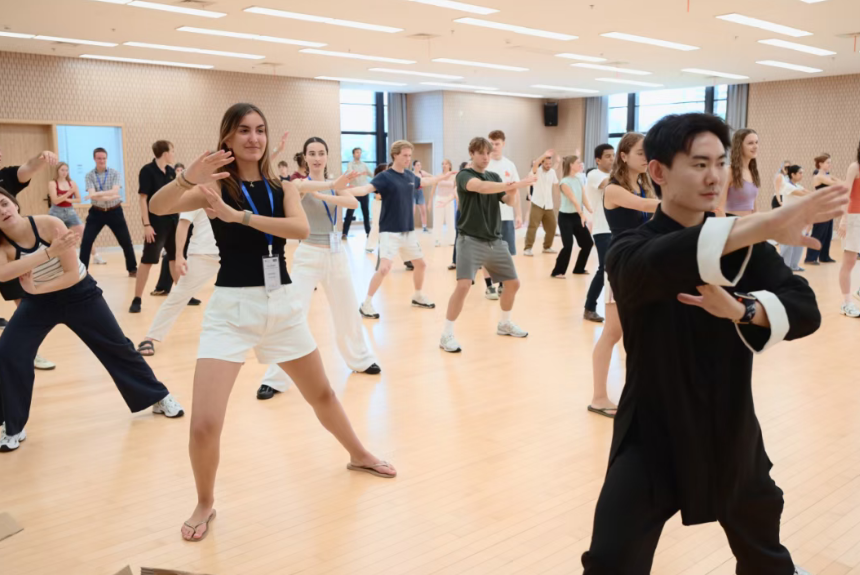
At the Shanghai International Arbitration Center, teachers and students learned about the latest rules, practices and international development of foreign-related arbitration in China. They visited the Shanghai Museum to appreciate the 5,000-year-old Chinese civilization; Walk into Century Publishing Group to understand the effectiveness of Chinese translation and rule of law culture dissemination; go to the site of the First Congress of the Communist Party of China to explore the historical logic of the development of the rule of law in China; Experience Tai Chi and Hanfu culture firsthand, and perceive the concept of order and harmony in China's excellent traditional culture.
Build a platform for deepening dialogue
Lectured by legal experts (swipe left and right to see more) This summer class closely follows the three cutting-edge topics of "modernization of China's rule of law", "comparison of Chinese and foreign legal systems" and "collaborative practice of foreign-related rule of law", and provides teachers and students with an immersive experience of the rule of law in China with the integration model of "theory + practice + culture". The project offers core courses such as "Chinese Constitutional Law", "Understanding Chinese Law", "Chinese Legal Culture" and "Chinese Commercial Arbitration", with well-known domestic legal experts as the keynote lecturers to systematically explain the theoretical foundation and latest practical achievements of China's rule of law.
"From the past few days, I have a clearer understanding of the similarities and differences between the legal systems of China and Belgium. In particular, it is very interesting how China's rule of law practice is integrated into social operation and the specific design of court litigation processes. Florian said.
Chen Nuo, a 2025 undergraduate student of the School of Law, volunteered at the event, "I really feel that promoting civilizational dialogue ultimately depends on close and face-to-face communication between people." Only in this way can we build stronger trust and get to know each other more comprehensively and concretely. Chen Nuo said that in the exchange with teachers and students in Leuven, he also had a deeper understanding of Belgium, "This equal and relaxed atmosphere of interaction is very precious."
Bernard Tilleman, former dean of the Faculty of Law at the University of Leuven, who led the delegation this time, hopes to use the summer school as a starting point to further expand academic exchanges between the two universities, promote student exchange programs and faculty research cooperation. In the future, more outstanding Belgian students will be encouraged to study in China and pursue higher-level degree programs.
It is reported that the Faculty of Law of the University of Leuven was founded in 1425, adhering to the spirit of "Sedes Sapientiae" (where wisdom is), and is the cradle of the birth and innovation of legal thought. On the occasion of the 600th anniversary of the founding of the University of Leuven, the 120th anniversary of the founding of Fudan University, and the 50th anniversary of the establishment of diplomatic relations between China and the EU, the "China Law Summer School" focuses on building a high-end platform for the rule of law related to foreign affairs through in-depth exchanges in the two dimensions of academic seminars and humanistic experience, so as to lay a solid foundation for mutual learning between Chinese and European civilizations, docking of rules and governance coordination.