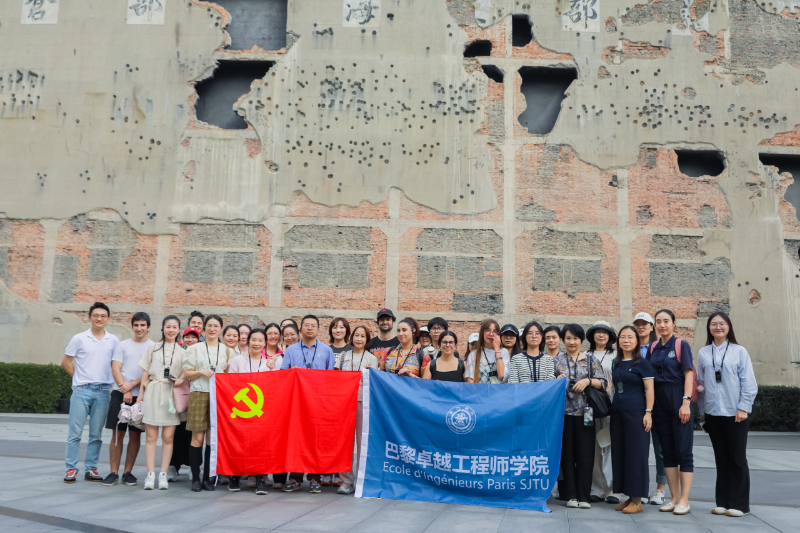
On October 15, in order to commemorate the 80th anniversary of the victory of the Chinese People's War of Resistance Against Japanese Aggression and the World Anti-Fascist War, the Paris Institute of Engineers organized more than 30 Chinese and foreign teachers and students to gather on the banks of the Suzhou River to carry out a City Walk activity with the theme of "Exploring the Memory of the City and Inheriting the Belief in Peace".
Teachers and students followed Zhu Yining, the international Jing'an promotion officer and founder of Heart City, retraced the footprints of the "Eight Hundred Heroes" on the banks of the Suzhou River, measured history with their footsteps, talked about the past with their hearts, relived the heroic epic of the "Four Lines of Lonely Army" while walking, and conveyed the vision of peace across national borders. It is worth mentioning that Ms. Xie Jun, the granddaughter of General Xie Jinyuan, participated in the event as a special guest with teachers and students. The event started from the Shanghai Sihang Warehouse Anti-Japanese War Memorial Hall. This building, which witnessed the bloody struggle of the "Eight Hundred Heroes", has now become an important landmark of the national spirit.
Zhu Run, deputy director of the Jing'an District Cultural Relics Protection and Management Service Center, expressed a warm welcome to everyone on behalf of the Shanghai Sihang Warehouse Anti-Japanese War Memorial Hall. Wang Shaobo, assistant to the dean of the college and secretary of the second party branch of the faculty and staff, said, "I hope that through this activity, we can break the 'sense of distance' of learning history in the traditional way." It is not only necessary to let teachers and students 'see' history, but also to let everyone 'enter' history. Every step is a dialogue with the hero; Every check-in is a tribute to peace. ”
Outside the memorial hall, teachers and students stared at the bullet-scarred Western Wall and listened to the history of defending national dignity to the death. Victor DERU, an international student from France, sighed deeply, "I used to only know about World War II from books, but standing here, I really feel the weight of history."
Walking along the Suzhou River: connecting the memories of the Anti-Japanese War
Leaving the Sixing Warehouse, teachers and students continued along the historical route along the Suzhou River, from Tibet Road and Bridge to Zhejiang Road and Bridge, from the former site of the Bank of China Stack to the former site of the Shanghai General Chamber of Commerce, each landmark carries a unique memory of the Anti-Japanese War and the urban context.
Standing on the Tibet Road Bridge, the voice of the tour guide led everyone's eyes to the other side: "80 years ago, the 'Eight Hundred Heroes' crossed this bridge to break through, and their figures were frozen in the morning light of the Suzhou River; Today, this bridge connects the past and the present, and also allows us to understand the strategic terrain at that time more intuitively." Chinese and foreign teachers and students raised their mobile phones to record the picture of "historical buildings and modern cities" in the same frame.
Before walking to the former site of the Bank of China stack, Zhu Yining told the teachers and students about the "dual identity" of the building: "During the Anti-Japanese War, it was the first stop of the 'Eight Hundred Heroes' after retreating from the Sihang Warehouse; Today, the building has been renovated and has become a creative space on the banks of the Suzhou River, where you can not only look back on history, but also see the vitality of the new era." ”
Next to the Zhejiang Road Bridge, Zhu Yining unveiled the process of the "Eight Hundred Heroes" crossing the Suzhou River through this bridge, taking a vehicle, and finally being sent to the lone military camp on Jiaozhou Road by displaying a set of precious historical photos taken by Associated Press photojournalist Hailan Lyon in 1937. The bridge, built in 1908, is still standing today, silently telling the history of the past.
Dialogue across borders: Let the idea of peace take root in the heart
The event came to an end in contemplation and emotion, but the dialogue and echoes across borders had just begun. This trip is not only a route trace, but also a profound spiritual resonance, teachers and students from different cultural backgrounds shared their unique insights:
Ms. Xie Jun, the granddaughter of General Xie Jinyuan, said that she was very happy to see so many international friends come to the Sihang warehouse to get closer to this history, and the form of Citywalk is of great significance to promote international youth to understand the spirit of the War of Resistance, and looks forward to more young people jointly inheriting this historical memory belonging to Shanghai and the world.
Wei Guanghua, director of the Student Innovation Center and secretary of the first party branch of the Paris Institute of Excellence Engineers, said that he used to think that "anti-Japanese war" was a term in textbooks, but now he knows that it is in every building and every road around us, and this kind of 'immersive learning' is more infectious than the classroom.
Milan PERERA, a French mathematics teacher at the Ecole des Écoles des Écoles des Écoles des Engineers in Paris, said that the immersive experience allowed me to perceive history through concrete examples, and the Battle of the "Four Lines Warehouse" was not only a microcosm of the Chinese people's struggle, but also showed the indomitable spirit of the Chinese nation.
As a lover of Chinese culture, I hope to become the narrator of this history, so that more international friends can understand the real China through personal experience.
As the sun sets, the historical buildings on the banks of the Suzhou River are draped in golden afterglow, and the voices of teachers and students still echo in the air. This "historical walk" across borders not only allowed the memory of the city to be inherited, but also allowed the concept of peace to take deep roots in the hearts of teachers and students at home and abroad. In the future, the college will continue to plan such historical and cultural activities to strengthen Chinese teachers and students, let foreign friends better understand the Chinese spirit, enhance friendship in civilization dialogue, and jointly contribute to world peace and development!