“I Was Blown Away the Moment I Walked In”: The “China Spa” Goes Viral as Foreigners Flock to 24-Hour Bath Centers
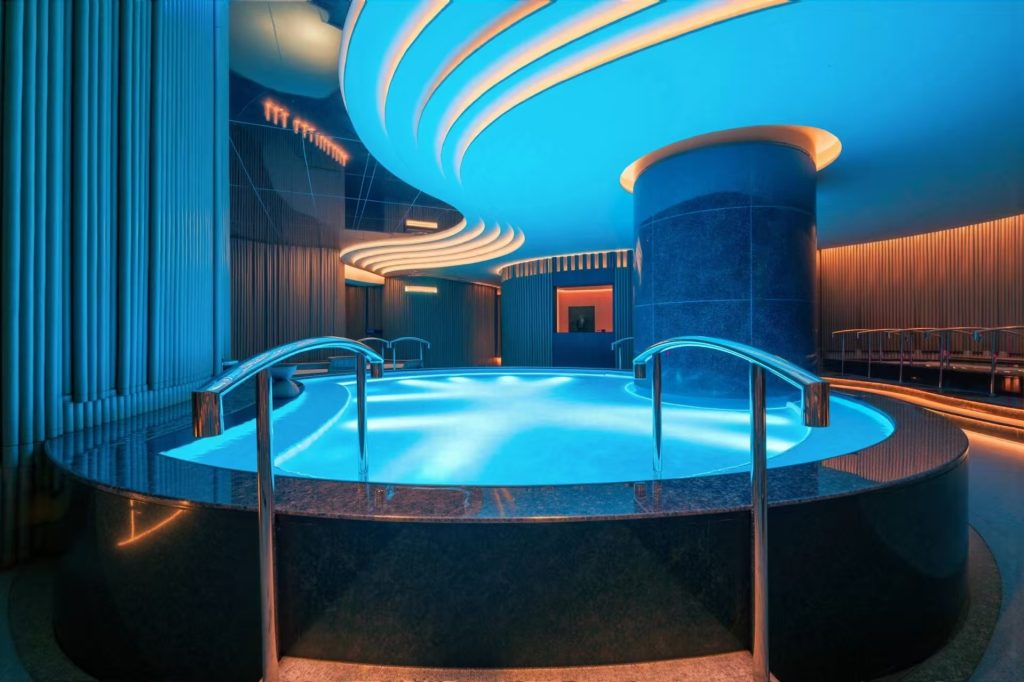
“I was shocked the moment I entered.” American influencer Yemi recently experienced a bath center in Beijing. Open 24 hours a day, for just $50 (approx. 344 RMB), she enjoyed unlimited fruit, drinks, ice cream, and popcorn, alongside various spa treatments.
The facilities left her dazzled: a quiet library, bean bags with gaming consoles, KTV rooms, billiard tables, claw machines, foosball, air hockey, and even private Mahjong rooms.
Yemi told Sino-Jingwei that a Chinese spa is a place where you can truly hang out, eat, and relax for hours, rather than just rushing in and out for a single treatment.
As the “China Travel” trend continues to boom, foreigners like Yemi are no longer satisfied with just sightseeing and taking photos. They seek a deeper experience of local urban culture and lifestyle exploration. On overseas social media, “China 24-Hour Spa” has become a “traffic password” (viral hook) for content creators.
What are foreigners doing in Chinese bath centers?
Sino-Jingwei recently visited the Shuiguo Tangquan (Sihui Branch) in Beijing to speak with several international tourists.
“The experience at Chinese bath centers is fantastic,” said Qiu Yiran (Chinese name), a visitor from Canada. Despite having lived in Beijing for only a few months, this was already her fourth visit to this specific center. “I love it here; the environment is quiet, and the facilities are complete.”
Qiu shared that she discovered the shop while searching online. “Not only is the space huge, but the variety of food and drinks is rich, and the view from the outdoor area upstairs is beautiful.” Speaking of her routine, she admitted it is incredibly relaxing: “I usually soak in the springs and do a face mask first, then go upstairs for a drink, some fruit, and maybe a movie. After that, I go back down for another soak. It’s so comfortable.”
Comparing it to similar venues in Canada, Qiu noted a stark difference: “Canada doesn’t have bath centers like this. We only have simple massage services where, at most, you can sit and have a cup of tea afterward. There are no 24-hour operations. I’ve only seen this in China and other parts of Asia. I wish we had this back home.”
During this visit, she also tried Gua Sha (body scraping) for the first time. “Canada has body scrubs, but it’s completely different from Gua Sha. It felt very novel.” Regarding the price, she found it perfectly acceptable: “For service like this, I’m willing to pay around 300 RMB. I’ll definitely be back; it suits me perfectly.”
A “Staycation” for the Whole Family
Simeon, a visitor from the UK, was visiting with his wife and child. “The UK has similar places, but they are much more expensive and not really suitable for families. I love it here because it’s great for kids.” He added that a similar experience in the UK would cost between £100 to £150 (approx. 912 to 1,369 RMB), making the Chinese version highly cost-effective.
Hadjira from France was spotted playing billiards with her husband. It was her first time in China, and she chose this location after seeing a viral video online. “I didn’t have high expectations, but it’s been wonderful. Everything is new to us because Europe has nothing like this.”
Yemi added that in the U.S., a spa visit is usually just a one-hour appointment. “In China, it feels more like a ‘staycation’ rather than just a treatment. I love this space that integrates leisure, food, cinema, and gaming all in one.”
Staff at the Sihui branch noted that since September 2025, the number of international guests has surged, with dozens arriving daily. Some visit once or twice a week, while others book via international travel platforms like Trip.com (Ctrip).
The Viral “Traffic Password” for Overseas Influencers
Irish vlogger Travis Leon recently posted a video of a “China 24-Hour Spa” in Chengdu, which garnered 9.57 million views. In the video, Travis claimed he spent $35 for all services: “Staying here overnight is cheaper than many hotels; the value is insane.”
His video sparked a wave of comments. Some users did the math, noting that at $35 a day, living in a bath center for a month might be cheaper than renting an apartment. Others commented: “Even with the cost of a passport and flight, staying in a Chinese bath center for six months could still save you money.”
Many video titles use words like “you won’t believe” or “insane.” Yemi described it as “the coolest experience of my trip.”
Experts: An Inevitable Product of Modern Tourism
Wu Liyun, a professor at the China Culture and Tourism Industry Research Institute (BISU), believes this trend is not an accident but an inevitable result of China’s inbound tourism entering a new stage.
She points out three fundamental differences between Chinese bath centers and foreign spas:
- Multi-functionality: Foreign spas are often single-purpose (just a massage or sauna), while Chinese centers integrate food, bathing, and diverse entertainment.
- High Cost-Performance: For 200–300 RMB, guests get an all-inclusive experience.
- Strong Social Function: It has become a social hub for families and friends to gather.
The 2025 National Bathing Industry Trend Report by Meituan shows that the industry has evolved from regional specialties (like Northern “scrubbing” vs. Southern “hot springs”) into a unified, all-in-one leisure model. In 2025, the industry’s transaction scale reached a peak, with a growth rate exceeding 20%.
Despite language barriers, many vloggers noted that staff are incredibly patient and helpful. Wu Liyun suggests that bath centers should further improve multi-language signage and staff training to better serve the growing wave of international guests.