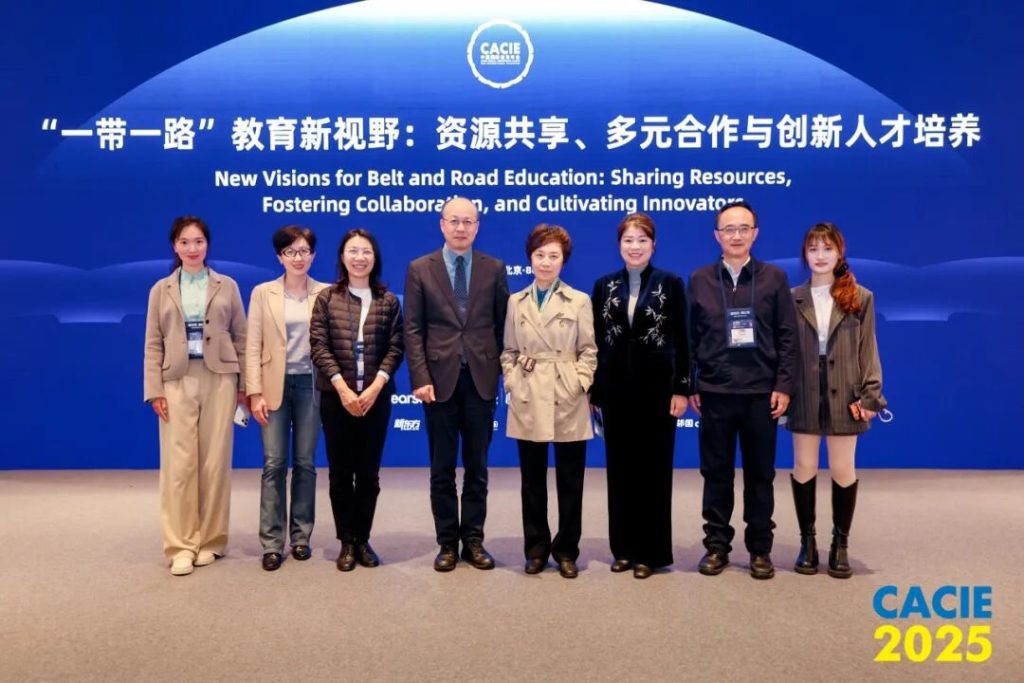
On October 29, 2025, the 26th China International Education Annual Conference "Belt and Road" Education International Exchange Forum, hosted by the China Education International Exchange Association and co-organized by the Editorial Department of Education International Exchange, the "Belt and Road" Education International Exchange Branch and Inner Mongolia University, was held in Beijing, with the theme of "New Horizons of 'Belt and Road' Education: Resource Sharing, Diversified Cooperation and Innovative Talent Training".
Jiao Yang, vice president of the China Education Association for International Exchange and former secretary of the Party Committee of Fudan University, and Chen Zhimin, vice president of Fudan University and chairman of the "Belt and Road" Education International Exchange Branch, attended the forum and delivered speeches. Fu Bo, Deputy Secretary-General of the China Education Association for International Exchange, released a summary of the "2024 Survey Report on the Development of the Internationalization of China's Higher Education" at the meeting. Su Kui, Director of the Office of Foreign Students at Fudan University and Secretary-General of the "Belt and Road" Education International Exchange Branch, presided over the meeting.
Su Kui, Director of the Office of Foreign Students of Fudan University and Secretary General of the Belt and Road Education International Exchange Branch, presided over the meeting.
Jiao Yang pointed out in his speech that educational exchanges are a key part of the high-quality joint construction of the "Belt and Road", and undertake the important mission of cultivating talents, enhancing mutual trust and promoting people-to-people ties. She stressed that all colleges and universities should actively align with the national development strategy, expand new space for cooperation, innovate talent training models, strengthen brand building, and enhance the international influence of "Chinese education". She called on all colleges and universities to work together to promote the development of international exchanges on education under the "Belt and Road" to a higher level with more enthusiasm and more pragmatic actions, and contribute more to building an educational power.
Chen Zhimin pointed out that educational exchanges are an important support for the construction of the "Belt and Road" and a key bridge to promote international talent training and cooperation. He stressed that all educational institutions should closely align with national strategies, deepen international cooperation, accelerate the cultivation of urgently needed talents under the "Belt and Road", build a resource sharing and cooperation network, and promote the development of global education governance in a fairer and more efficient direction.
During the forum, Fu Bo released a summary of the "2024 Survey Report on the Development of the Internationalization of China's Higher Education". The report pointed out that with the strong support of national policies, the internationalization of China's higher education has progressed steadily and achieved remarkable results. The strategic layout of internationalization of colleges and universities has been continuously improved, and the opening up of education to the outside world has achieved remarkable results. The widespread application of digitalization and artificial intelligence technology has brought new vitality to international teaching, promoted the innovation of teaching models, and made the international flow of teachers and students more frequent. While improving quality and efficiency, Sino-foreign cooperative education pays more attention to connotation development. The "Belt and Road" education exchanges and cooperation continue to deepen.
In the future, the association will focus on consolidating the information platform and strengthen authoritative guidance; deepen scientific research cooperation and enhance international influence; Innovate college services and provide precise empowerment to promote the international development of higher education.
Minister Counsellor and Deputy Director of the Mongolian Embassy in China, Chen Xing, Vice President of Beijing Normal University, Dahu Baiyila, Vice President of Inner Mongolia University, Wang Lei, Deputy Secretary of the Party Committee and President of Shaanxi University of Technology, Tian Shili, Secretary of the Party Committee of Zhengzhou Electric Power College, Ma Lei, Director of the International Cooperation and Exchange Office of Southwest Jiaotong University, Chen Guangrong, Vice President of Guangdong Construction Vocational and Technical College, Feng Liwei, Vice President of Jiaxing Nanyang Vocational and Technical College, Yang Suping, Director of the ASEAN Comparative Education Research Center of Nanning Normal University, Keynote speeches were delivered respectively.
In his speech, Gongbu Bumutseende mentioned that the educational cooperation between China and Mongolia has been deepening, and about 6,300 Mongolian students are currently studying in China, of which more than 800 are enjoying Chinese government scholarships. In addition, Mongolia has carried out several educational cooperation with the Inner Mongolia Autonomous Region, including teacher training and Chinese language teaching programs. The minister said that in the future, he hopes to focus on promoting the digitalization and green development of education on the basis of existing cooperation, and create a demonstration model of "Belt and Road" education cooperation.
Chen Xing emphasized that education is the "first move" of the "Belt and Road" connectivity. Beijing Normal University has continued to strengthen resource sharing, expand diversified cooperation, and cultivate innovative talents with the Belt and Road College as a platform, and has cultivated a large number of high-quality talents for countries along the Belt and Road. Looking forward to the future, the university will further focus on high-level talent training, scientific research collaborative innovation and international cooperation in basic education, actively build a global education cooperation network covering a wide range, deepen mutual learning among civilizations and people-to-people ties, and continue to inject educational momentum into the high-quality development of the "Belt and Road".
Dahu Baiyila shared the practice of "Belt and Road" cooperation and the fruitful results of exchanges with Mongolia in various fields, showing the positive actions of border universities in the construction of the "Belt and Road". He pointed out that the construction of the "Belt and Road" requires border universities to undertake the mission of compound talent training, joint scientific research and mutual cultural learning. With its unique location advantages and deep relationship of cooperation with Mongolia, Inner Mongolia University adheres to the principle of long-term cooperation, and has achieved remarkable results in many fields. In terms of disciplines, the Mongolian studies discipline group has been formed and improved, and more than 3,200 Mongolian students have been trained, and it has been selected as a national collaborative training and innovation base for foreign-related legal talents. More than 220 national projects have been approved, multiple academic platforms have been built, and academic exchanges and teacher-student visits have been carried out regularly. Participated in the preparation of the launch ceremony of the relevant version of "Xi Jinping on Governing the Country" and trained primary and secondary school teachers in Mongolia. He summarized the enlightenment of international cooperation in border universities from six aspects, including location and improvement of mechanisms, and provided reference for similar universities.
Wang Lei shared the new model of international industry-education integration of Shaanxi University of Science and Technology "from Hanzhong to Central Asia". As an undergraduate application-oriented university located in Zhang Qian's hometown, Shaanxi University of Technology relies on its location advantages and works closely with 8 universities in Central Asia to train nearly 100 Central Asian students, build more than 20 Chinese overseas internship bases, and continuously hold the "Chinese Bridge" project to promote cultural mutual learning. The university focuses on exploring digital and intelligent education, carries out green technology cooperation in various fields, participates in the construction of the China-Kyrgyzstan higher education community, and helps the construction of a China-Central Asia community with a shared future.
Tian Shili said that Zhengzhou Electric Power College actively responded to the "Belt and Road" initiative, gave full play to the advantages of enterprises in running schools, and promoted the high-quality development of international cooperation in vocational education with the integration of industry and education, and won the second prize of the National Teaching Achievement Award. The school has established the "China-Africa Electric Power Silk Road College" in Rwanda, the "Chinese Workshop" and the "China-Nepal Electric Power Silk Road College" in Nepal to provide Chinese vocational education programs to the world.
Ma Lei shared the practice of Southwest Jiaotong University in promoting the integration of education along the "Belt and Road". In view of the shortage of talents and language barriers faced by high-speed rail "going overseas", the school took the lead in establishing the Railway International Talent Education Alliance, building a multi-dimensional system covering talent training, standard formulation, overseas school running, etc., and has trained thousands of technical talents from more than 50 countries along the line, and jointly built overseas "Tianyou Railway Academy" in Thailand, Uzbekistan, Hungary and other countries. In the future, we will continue to deepen cross-border education cooperation through policy coordination and resource sharing, and help countries along the "Belt and Road" to connect and develop with high quality.
Chen Guangrong used specific data and cases to introduce in detail the practical experience of internationalization of vocational education in the Guangdong-Hong Kong-Macao Greater Bay Area. He pointed out that the Greater Bay Area has been deeply integrated with the global industrial layout, and has jointly built a vocational education highland in the Bay Area through multiple paths such as cooperative schooling, studying in Guangdong, and education going overseas. In addition, the vocational education overseas brand "Lingnan Craftsman College" launched by Guangdong is focusing on building a "vocational education standard sharing station, a foreign enterprise service station, a business exchange display station, and a talent cooperation liaison station", providing a solid carrier support and platform guarantee for the internationalization of vocational education in the Greater Bay Area.
Feng Liwei shared the experience of Jiaxing Nanyang Vocational and Technical College in promoting high-quality vocational education overseas. The school has built a double-ring driving path of "introducing international standards - local standards going global". With the "Silk Road College" as the carrier, the school and Kyrgyzstan carry out four-dimensional mutual recognition of "professional standards, post standards, professional standards, and curriculum standards", forming a new paradigm of cross-border cooperation with the four-way linkage of "government, school, industry and enterprise"; Innovative talent training by creating a "digital intelligence + practical + compound" training system; By forming a new link of "talent-enterprise-industry" linkage to go overseas, we will empower the coordinated development of cross-border e-commerce and regional industries, form a replicable and generalizable "Jiaxing model", and contribute the wisdom and strength of vocational education to serve the national strategy and build a community with a shared future for mankind.
Based on 12 typical cases of China-ASEAN higher vocational education cooperation, Yang Suping used the fuzzy set qualitative comparative analysis method to identify two efficient paths: "dual-core intensive resource-talent intensive" and "diversified collaborative development", and pointed out that "cultivating international technical and skilled talents" is a necessary condition for the success of cooperation. At the same time, three major suggestions are put forward: strengthening the co-construction and sharing of educational resources, systematically promoting talent training, and building a cooperative community with the participation of multiple subjects, which provides theoretical support and practical reference for promoting the construction of the China-ASEAN vocational education community.
The forum attracted more than 200 representatives from colleges and universities at all levels, various educational institutions and enterprises to discuss the high-quality development of international exchanges and developments in the "Belt and Road" education.