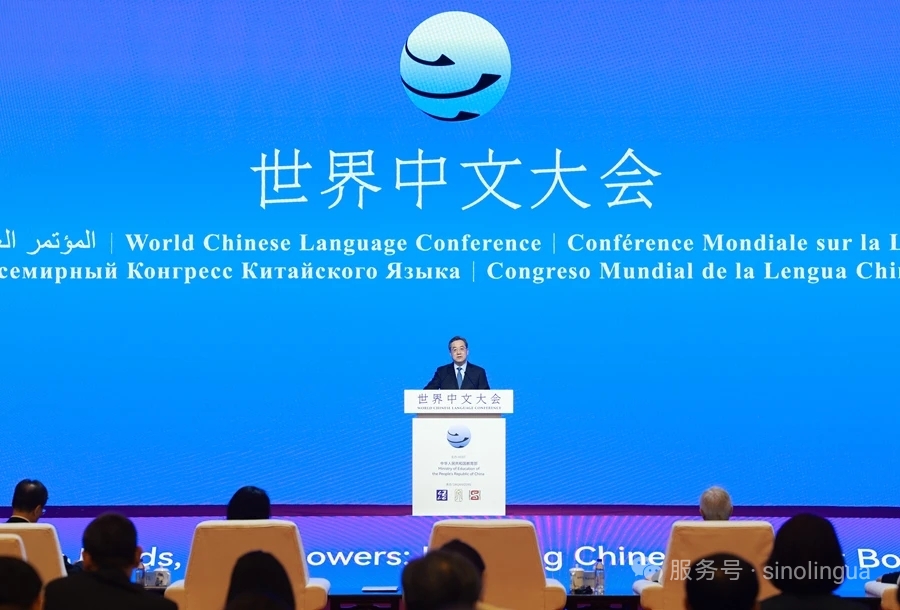
From November 14th to 16th, the 2025 World Conference on Chinese was held at the National Convention Center in Beijing. Nearly 5,000 people from more than 160 countries and regions, including education authorities, heads of Chinese and foreign universities and envoys to China, attended the conference.
From November 14th to 16th, the 2025 World Conference on Chinese was held at the National Convention Center in Beijing. Nearly 5,000 people from more than 160 countries and regions, including education authorities, heads of Chinese and foreign universities and envoys to China, attended the conference. The reporter noticed that the "breadth" and "depth" of Chinese serving international economic and social development and mutual learning among civilizations complemented each other at the conference site.
Learn Chinese well and open up broad development prospects
At present, Chinese has been included in the national education system of 86 countries, and the total number of international Chinese learners and speakers exceeds 200 million. The "Chinese Bridge" series of Chinese competitions has attracted more than 1.8 million young people from more than 160 countries and regions to participate. Behind the "Chinese fever" is the attraction of Chinese culture and the broad development prospects brought by proficiency in Chinese.
Currently, more than 30,000 Thai students are studying in China. "Thailand is working to help the younger generation acquire core future-ready skills, digital literacy, critical thinking and multilingualism. Among these abilities, Chinese is an indispensable bridge. Thai Minister of Education Naratmun Pinyushwa pointed out the importance of learning Chinese. China is at the forefront of global innovation. Chinese is the gateway to economic, scientific and technological and academic cooperation with China. Naratmun Pinyushwa said that Thailand will continue to promote and expand Chinese programs in the fields of basic education, vocational education and higher education.
As early as 2012, the Confucius Institute was established at Auster University in Northern Ireland, UK. After years of development, the Confucius Institute of AOSITE University has formed a Chinese teaching model with distinctive characteristics. The college works with more than 160 primary and secondary schools and universities in the local national education system, benefiting more than 20,000 learners each year, from preschool children to the elderly. "This all-round education model has won widespread praise from students, parents, schools and people from all walks of life, and has become a cherished high-quality educational resource in Northern Ireland and enjoys a high reputation in the local area." Auster University Vice President Xi Nan proudly said, "We strive to ensure that students have a clear understanding of the importance of Chinese on a global scale when considering international career paths. The "New Sinology Program" doctoral program was established by the Center for Chinese and Foreign Language Exchange and Cooperation (hereinafter referred to as the Center for Language Integration) of the Ministry of Education, aiming to cultivate young sinologists with international academic vision, knowledge of international academic rules, and ability to participate in international academic exchanges and research.
Dudi, a young sinologist from Cameroon, is a beneficiary of the program. Dudi said that through the whole chain of training and whole-process services provided by the "New Sinology Program", his life has changed greatly. After returning to China, he served as the Governor General of Chinese at the Ministry of Secondary Education in Cameroon, where he participated in the training of more than 300 Chinese teachers, making Cameroon one of the countries with the largest number of native Chinese teachers in Africa. Dudi's academic path has also become wider and wider, and he has published a number of academic works on China. Du Di said with deep feeling: "Sinology is not only an academic study of China, but also a moral responsibility to promote the integration of Chinese and foreign civilizations and serve the development of human society. ”
HSK upgrade, defining a new benchmark for Chinese learning
"From 2004 to 2024, the scale of the global paid test for the Chinese Proficiency Test (HSK) has increased by 21 times, with the number of annual reference candidates increasing from 32,000 to 719,000, and the number of test points expanding from 61 test centers in 34 countries to 1,477 test centers and more than 30,000 test rooms in 168 countries. In the first half of 2025, there will be 414,000 paid candidates, a year-on-year increase of 19.6% over 2024, and it is expected to reach 750,000 throughout the year, with a cumulative number of candidates exceeding 8.5 million. "On the eve of this year's conference, this set of figures released by the Language Cooperation Center shows the popularity of HSK.
During the conference, the Center for Language Cooperation launched the Chinese proficiency test HSK version 3.0, pioneering the integration of graded examinations and cross-level examinations, adding the HSK level 7 to 9 examinations of "one volume and three tests" across levels, and continuing to play the evaluation guiding role of HSK, further increasing the examination of paragraphs, discourses and stories related to contemporary Chinese social development, scientific and technological progress, ecological civilization construction, etc., to help learners understand real, three-dimensional and comprehensive China.
In addition, according to the theory of cross-cultural communication, the test of candidates' ability to translate their mother tongue into Chinese has been added to the level 7 to 9 exam. "HSK3.0 will optimize the content and form of the examination, strengthen the content of Chinese + professional education and Chinese + vocational education, accelerate the development of HSK online examination, expand HSK study in China and employment services, further play the role of HSK education evaluation and guidance, promote the improvement of international Chinese education teaching methods, help foreign Chinese learners better learn Chinese and understand China, and provide important basic support for the construction of an important education center with global influence." The relevant person in charge of the Language Cooperation Center said.
Empowered by digital intelligence, "Chinese zero distance" is no longer far away
China has always been committed to providing more high-quality international Chinese language education resources and public goods. With the theme of "Innovation Leads Digital Intelligence Empowerment - Let Chinese Zero Distance", this conference focused on the release of a number of digital intelligence achievements, marking a new level in the construction of China's Chinese international education resources.
According to reports, the development of relevant achievements follows the "International Chinese Proficiency Level Standards for Chinese Education" and "HSK3.0 Examination Syllabus", fully integrates artificial intelligence technologies such as large language models, and will be jointly built and shared with relevant institutions to serve the majority of international Chinese learners.
"International Chinese education led by innovation and empowered by digital intelligence has made 'Chinese zero distance' more and more possible." Zhong Yinghua, president of the World Chinese Language Teaching Association, pointed out, "Various adaptive platforms, large language models, Chinese learning agents, and digital intelligence teaching resource development have been launched, allowing learners to directly contact the Chinese natural language, which has promoted the wide-area coverage of Chinese teaching, the ubiquitous learning form, and the improvement of teaching quality and efficiency." ”
"How to promote the new vitality of Chinese in the digital age is a topic of the times that we must answer in depth." Lin Shangli, president of Renmin University of China, said that the influence of Chinese is moving from the 1.0 stage of "going out" to the 2.0 stage of "integration", and it is necessary to rely on big data, cloud intelligence, digital restoration and other technical means to make Chinese an open public cultural resource, so that Chinese can truly become a bridge that connects hearts and promotes understanding.