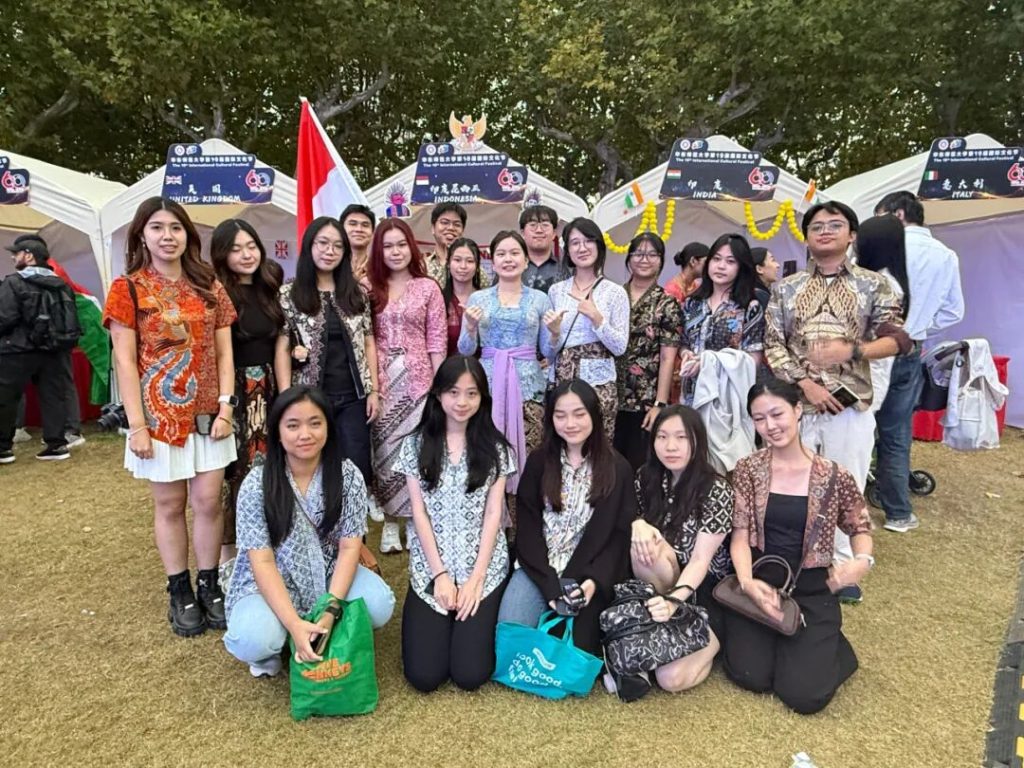
On October 19, 2025, the 19th International Cultural Festival of East China Normal University came to a successful conclusion. As a cultural feast that brings together diverse civilizations, Mini Expo has attracted students from 73 countries on five continents to actively participate, and students from all over the world have shown their own characteristics - from gorgeous traditional costumes, authentic special food, to vivid art performances and profound cultural heritage, showing the unique charm of different countries in an all-round and multi-angle way, and jointly creating an international cultural carnival with a fascinating and long aftertaste.
At this moment, let's listen to their voices and immerse ourselves in the harvest and growth brought by this cultural integration.
01Indonesia 🇮🇩 Indonesia "Warung": A warm window to experience the soul of the archipelago
The Indonesian booth is themed around the "Warung", a canteen that can be seen everywhere on the streets of Indonesia, and is composed of bright batik cloths (Batik), rustic bamboo decorations, passionate Indonesian music, and an open "food selection station". Convey "fireworks" with home-cooked food
In order to let everyone feel the real life in Indonesia, the students specially prepared several everyday home-cooked delicacies such as chicken satay, vegetable pancakes and fried tempeh. Among them, they specifically introduced Tempeh, which is known as Indonesia's "superfood". This food, made from naturally fermented soybeans, is rich in protein and was historically an important substitute for meat, and now it is a common delicacy on the table from the presidential palace to the people's homes. Finding authentic spices in a foreign country is challenging, but in order to restore the taste of their hometown, they either look for alternatives or bring core seasonings from their hometown, just so that every taster can "travel" to the real Indonesian streets through their taste buds.
The booth is small, but it is like a condensed museum of Indonesian culture. The Cirebon Mask Dance uses five different coloured masks to interpret the different stages and personalities of life. Garuda Pancasila, also known as the national emblem of Indonesia, features a divine condor Garuda, reflecting the unity of Indonesia's diverse cultural context. These objects are not cold exhibits, but "part of our lives", carrying Indonesia's rich history and the emotions of its people. Feel the "smile everywhere"
When asked what cultural traits are most likely to surprise other students, they invariably mention the "ubiquitous smile" and "slow down" attitude towards life. "We value human connection, and no matter how busy we are, we are willing to spend time chatting with friends over coffee in Warung," one student said with a smile, "This optimism and calmness are probably the most touching part of our culture." ”
In their opinion, the information in books and on the Internet is far less real than what they feel in person. They hope to build a real cultural bridge through this cultural festival. "When you touch the batik cloth with your own hands and taste the sweetness and spiciness of satay with your own mouth, culture is no longer an abstract concept, but a real memory and emotion." A warm invitation from the Land of the Thousand Islands
But "Warung" is much more than a "place to sell things". "It is the soul of Indonesia, a gathering place for food, and a liaison between people's emotions," said Wen Minglan, the person in charge of the booth. This is why they chose this theme - they want visitors to experience not only "Indonesian food", but also the most authentic "Indonesian taste" and the "taste of mother" contained in it.
"What we want you to push open is not just a classroom door, but a window into everyday life in Indonesia. Through this window, you can intuitively feel the hospitality, optimism and wisdom of finding happiness in simplicity of the Indonesian people. They hope that after the cultural festival, everyone will remember that Indonesia is rich in natural and cultural resources, but also a country full of warmth and goodwill, and will always open its arms to the world.
02 Morocco 🇲🇦 "Let the World See Morocco"
2018 was the starting point of my story with the China Normal University Cultural Festival. At that time, when I first arrived at school, I didn't even know Chinese, and there were no other Moroccan compatriots around me, but in order to represent the motherland well, I stayed up for several nights to prepare Moroccan food and special decorations.
I thought it would be very tiring, but when I saw the audience around the booth asking questions curiously, and my eyes lit up after tasting Gusmi, I instantly fell in love with this festival. What's even more memorable is that this is a good opportunity for me to meet alumni - I can hold the tom yum soup handed over by my Thai classmates, turn around and take the burritos, and dance hand in hand with classmates from all over the world to the music, and laugh happily even when my steps are messy. It was a lively experience for the audience, and for our students, it was a precious time full of food and laughter.
Later, the cultural festival became my annual choice, and when I returned to school in 2023, I specially brought a box full of specialties from Morocco, and asked the teacher for the first time the time of the cultural festival, wanting to continue this happiness.
03塞尔维亚🇷🇸From Onlooker to Leader: Serbia's ECNU Cultural Festival Journey
As I was the only student from Serbia last academic year, I was feeling disheartened about organizing the Serbian booth, so when I was contacted by one of the teachers asking me if I would like to participate this year, as there were new students from Serbia arriving this year, I was very pleasantly surprised. I agreed to do it, I asked for the contact information of these new students, and so my journey as the Serbia booth coordinator for the 2025 ECNU International Culture Festival began! Meeting the new students from my country was a wonderful experience, we were all enthusiastic about representing our country (as it hadn’t been represented for several years), and we all quickly became good friends. I planned out how our booth would look and what materials we would need to collect, but I had help with the poster and promo material design from my fellow Serbian students, as most of them come from the Design master's program. We also received help from the Consulate of Serbia in Shanghai, as they were kind enough to offer us some promotional materials as well as an additional national flag. After about two weeks of preparation, everything was set, and we were all excited about the festival! I shared with them my experience as a visitor last year, but I had no idea what it would look like as an active participant, which is something that we were all looking forward to. The festival started with the opening ceremony, and as I walked on the main stage carrying the Serbian flag, I felt that I had finally made it, and Serbia had made it to ECNU. My colleagues helped set up the booth, and we started with the operation shortly after. As last year I swore that I would represent Serbia, I was proud to show the booth to all my friends who were there last year, I showed everyone that I had kept my promise. The booth was a success, as we all made a lot of friends, talked about Serbia with a lot of curious visitors, and of course let them try the Serbian dish we made. It was a great day! Overall, it was a lot of fun, and I learned a lot about how to organize a project like this, so I hope that next year we can do it again and continue to improve!
华东师范大学(East China Normal University)
简称华东师大, 是位于中国上海市的一所综合性研究型大学。 该校由教育部主管,教育部与上海市人民政府重点共建。
East China Normal University was established on October 16, 1951, based on Daxia University and Guanghua University, and transferred to some departments of St. John's University, Fudan University, Tongji University and Zhejiang University, and was founded on the original site of Daxia University. In 1959, the school was identified by the Central Committee of the Communist Party of China as one of the 16 key universities in the country. In 1972, the school merged with Shanghai Normal University, Shanghai Institute of Sport and other institutions and changed its name to Shanghai Normal University. In 1978, the school was again recognized as a national key university. In 1980, the school restored the name of East China Normal University. In 1996, it was included in the ranks of national key construction universities in the "211 Project". In 2006, the Ministry of Education and Shanghai decided to focus on jointly building East China Normal University, and the school entered the ranks of national "985 Project" universities. In 2017, the school entered the ranks of national "world-class universities" construction universities. Famous scholars such as Hu Shi, Li Linsi, Xu Zhimo, and Huang Yanpei have taught at the school.