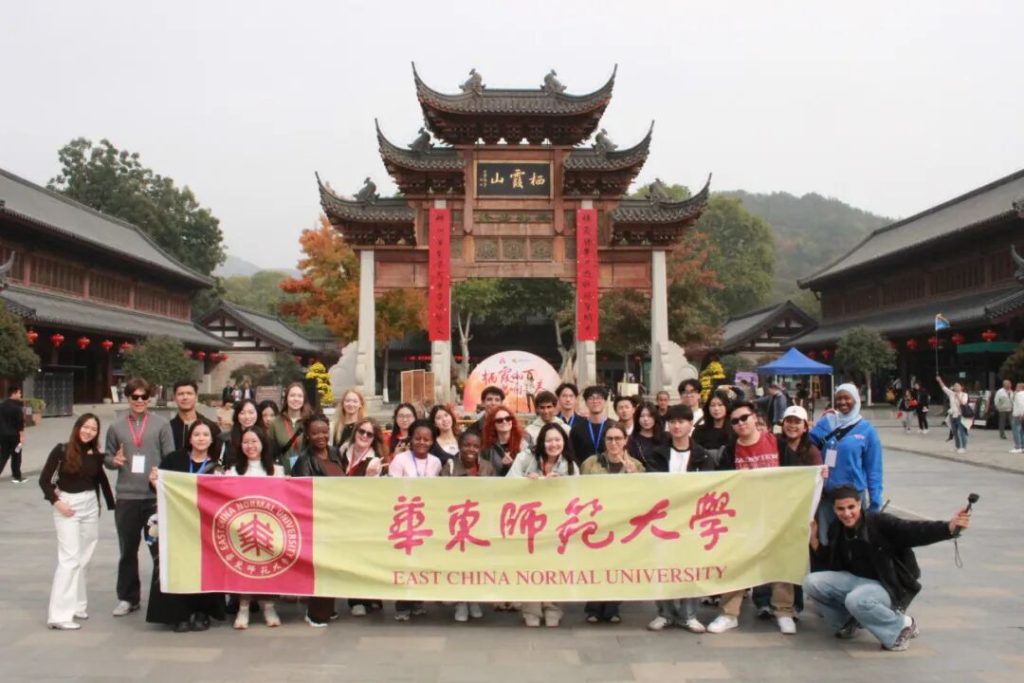
From October 31st to November 2nd, the International Education Center of East China Normal University held the "Second Classroom" cultural inspection activity for international students, attracting nearly 160 international students to participate. This cultural expedition carefully planned two routes to Shaoxing and Nanjing respectively, leading the students out of the classroom to experience the local traditional culture and modern social development, and enriching the students' extracurricular learning experience.
From October 31th to November 2nd, the Global Education Center held a “second classroom” activity for international students, which attracted nearly 160 international students to participate. The big group was divided into two routes: Shaoxing and Jiangxi.
Route 1 Shaoxing SHAOXING
Keqiao Ancient Town
On the first day, we arrived at Keqiao Ancient Town, where the ancient bridge was connected to the white walls and tiles on both sides, and the black canopy boat rowed leisurely. The students listened to Wu Yin in the theater and watched the Ugan dishes dried by the locals at the bridgehead.
On the first day at Keqiao Ancient Town, the students attended a traditional opera performance and observed locals airing dark dried mustard greens at the bridgeheads.
In the tour guide's explanation, the students understood that the ancient bridge is not only a poetic embellishment, but also an artery of ancient commerce.
Through the guide's explanation, we came to understand that the ancient bridges served not merely as scenic landmarks, but as vital arteries of commerce and trade in ancient times.
Lanting
The next day, the students came to the Lanting, the holy land of calligraphy. The bamboo forest is quiet, the stream is gurgling, as if you can still hear the poetry of thousands of years ago. The ritual of the winding water is reproduced here, and the teacup carries elegance and flows down the river.
On the second day, the group visited Lanting, the sacred site of Chinese calligraphy.
The on-site docent also explained to the students the twenty characters of "zhi" in different forms in the "Preface to the Orchid Pavilion", and took everyone to identify the evolution of the seal script and cursive script engraved on the stele, so that the students had a more three-dimensional understanding of traditional Chinese calligraphy culture.
The students participated in the traditional "Qu Shui Liu Shang" ceremony, and on-site instructors elaborated on the twenty distinct forms of the character "Zhi" in the Lantingji Xu, thereby deepening their understanding of traditional Chinese calligraphy culture.
沈园&鲁迅故里Shen Garden and Lu Xun's Former Residence
下午同学们先参观了沈园,在古色古香的江南庭院里读到了陆游与唐琬动人的爱情故事。
In the afternoon, we visited Shen Garden, a Jiangnan-style courtyard garden, where we learned about the poignant story of Lu You and Tang Wan.
在鲁迅故里,从百草园到三味书屋,从碧绿的菜畦到刻着"早"字的书桌,课本里的文字在眼前一一具象。 同学们站在先生曾玩耍过的天井里,忽然读懂了那一句"其实地上本没有路,走的人多了,也便成了路"——这不仅是对故乡的回望,更是对青春的勉励。
At Lu Xun's former residence, we visited Baicao Garden and Sanwei Study Hall, where the verdant vegetable plots and the desk inscribed with the character "Zao" brought textbook descriptions vividly to life.
柯岩Keyan
第三天,同学们迎着晨光走进柯岩。 神奇的云骨石拔地而起,大佛庄严静立,鉴湖如镜,倒映着天地。 On the third day, we visited Keyan, where we beheld the towering Yungu Stone, the majestic Grand Buddha, and the mirror-like Jianhu Lake.
而鲁镇,则是把鲁迅笔下的世界活灵活现呈现在我们眼前。
Lu Town, in turn, brought the world of Lu Xun's literary works to life before our eyes.
线路二 Route 2南京 NANJING
夫子庙Confucius Temple 第一站抵达了南京夫子庙。
The first stop was Nanjing's Confucius Temple.
同学们漫步在夜色里的街巷中,被街边琳琅满目的特色小店吸引,纷纷品尝鸭血粉丝汤、盐水鸭等南京特色小吃。
As the students strolled through the streets and alleys in the evening, they were drawn to the specialty restaurants lining the roadside and sampled authentic local snacks such as duck blood vermicelli soup and salted duck.
南京古城墙Ancient City Wall of Nanjing
第二天来到南京古城墙——是中国现存规模最大、保存最完整的古代城垣之一。
On the second day, the group visited the ancient city wall of Nanjing—one of the largest and most completely preserved ancient city walls extant in China.
同学们沿着城墙缓步前行,触摸着历经岁月沧桑的墙砖,聆听着关于古城墙建造背景、历史变迁的讲解,仿佛穿越时空,真切感受到古代中国人民的智慧与匠心,深刻体会到南京作为历史文化名城的独特底蕴。
While climbing the wall, we listened to explanations of its construction background and historical evolution, gaining an appreciation for the wisdom of the ancient Chinese people and the profound historical and cultural heritage of Nanjing.
栖霞山Qixia Mountain
下午,同学们前往栖霞山,邂逅南京的秋日盛景。
In the afternoon, the students proceeded to Qixia Mountain to experience Nanjing's autumn.
此时的栖霞山,漫山遍野的树木逐渐开始换上红、黄、橙等色彩斑斓的盛装,宛如一幅绚丽多彩的油画。 同学们沿着山间步道悠闲爬山,感受着中国秋日的独特魅力。
The mountain's foliage had turned vibrant shades of red, yellow, and gold, resembling an oil painting. During their ascent, we experienced the unique charm of autumn in China.
无锡惠山古镇Huishan Ancient Town in Wuxi
第三日,同学们前往无锡惠山古镇。 这里历史悠久,拥有众多古祠堂、古民居,充满了浓郁的江南水乡风情与人文气息。
On the third day, we traveled to Huishan Ancient Town in Wuxi. The town is home to numerous ancient ancestral halls and traditional residences.
同学们漫步在青石板路上,参观古朴典雅的祠堂建筑,感受古镇深厚的历史文化积淀;还不时与当地居民交流,了解古镇的生活习俗与传统文化,在轻松愉快的氛围中进一步感受中国江南地区的人文风情。
We visited the ancestral hall architecture, and engaged with local residents to gain insights into their living customs and traditional culture.
East China Normal University
East China Normal University is a comprehensive research university located in Shanghai, China. The school is supervised by the Ministry of Education, which is jointly built by the Ministry of Education and the Shanghai Municipal People's Government.
East China Normal University was established on October 16, 1951, based on Daxia University and Guanghua University, and transferred to some departments of St. John's University, Fudan University, Tongji University and Zhejiang University, and was founded on the original site of Daxia University. In 1959, the school was identified by the Central Committee of the Communist Party of China as one of the 16 key universities in the country. In 1972, the school merged with Shanghai Normal University, Shanghai Institute of Sport and other institutions and changed its name to Shanghai Normal University. In 1978, the school was again recognized as a national key university. In 1980, the school restored the name of East China Normal University. In 1996, it was included in the ranks of national key construction universities in the "211 Project". In 2006, the Ministry of Education and Shanghai decided to focus on jointly building East China Normal University, and the school entered the ranks of national "985 Project" universities. In 2017, the school entered the ranks of national "world-class universities" construction universities. [3] Famous scholars such as Hu Shi, Li Linsi, Xu Zhimo, and Huang Yanpei have all taught at the school.