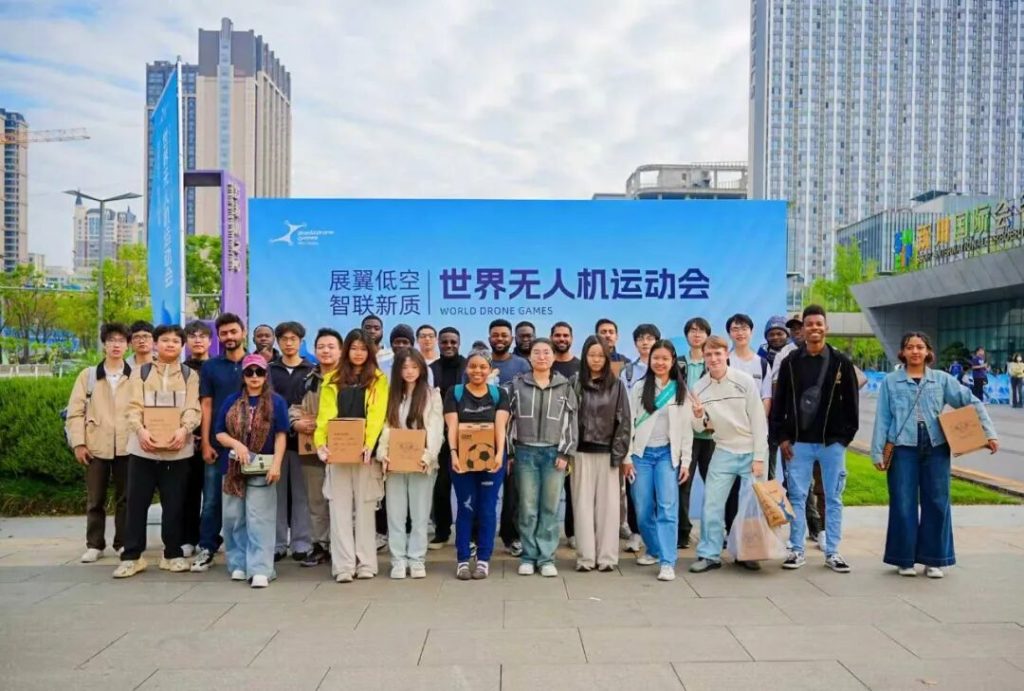
On April 11, the first World Drone Games, co-hosted by the China Communications Industry Association and the University of Electronic Science and Technology of China (UESTC), and organized by the Sichuan UAV Academy and Chengdu Communications Investment Group, officially commenced at the Xinchuan Heart Robot Park in the Chengdu Hi-Tech Zone. A representative team of international students from UESTC participated in the event, competing on the same stage as elite teams from all over the world.
As the world’s first original drone sports IP, this competition was divided into three major competition zones: Hi-Tech, Jintang, and Chenghua. It included innovative categories such as drone fencing, weightlifting, basketball, equestrianism, and low-altitude intelligent control, deeply integrating entertainment with cutting-edge technical challenges. The event attracted more than 800 teams, including 30 international squads from countries and regions such as Russia, Myanmar, Cameroon, Pakistan, and Tanzania.
The UESTC international student representative team consisted of over 20 students from different countries and majors. On the first day of the games, they participated in the drone basketball competition, demonstrating the professional caliber and teamwork spirit of UESTC students to the world through their outstanding performance. Notably, the group consisting of Russian student Daniil (Chen Guang), Panamanian student Luo Lai Ana Karina (Luo Enling), and Chadian student Ousama (Wang An) won third place in the drone basketball event. After the match, several players were interviewed by mainstream media, sharing their insights and feelings from the competition. Related coverage has been broadcast on platforms including CCTV Finance and Sichuan TV.
Luo Lai Ana Karina, a participant from the Republic of Panama, shared her competition experience and impressions of Chengdu. She noted, “This is my second time participating in a drone competition, and Chengdu’s capability in hosting drone events is truly outstanding. The overall atmosphere of the competition was excellent, and everyone was very enthusiastic.”
Daniil, a participant from Russia, spoke highly of the games and China’s achievements in the drone field. He shared, “There are many high-level experts among the athletes, and the equipment is very advanced. The things I am accessing in Chengdu now might not be accessible in Russia for another five years.”
Helina, a participant from Ethiopia, shared her experience: “This is my first time participating in this competition, and it is so exciting. It was a bit difficult because we were outside the main arena where there was wind, and the drones are very light. When you try to control it, the wind always blows it off course, so it was a bit hard, but also very fun.”
Chuan Xinrui, a participant from Myanmar, stated, “I not only participated in this competition, but I also ate Chengdu’s delicious food and saw the extraordinarily beautiful scenery.”
Ousama, a participant from Chad, spoke from a broader perspective: “Since arriving in Chengdu in 2023, I have witnessed the immense development of Chengdu in multiple technological fields every year. In terms of drones, I have seen various projects and competitions. Therefore, I believe that drone technology has a very bright future in China. I believe that by personally participating in this competition, I can bring the experience I gained here back to my country and let more people know about this sport. For us international students, studying in China and participating in such competitions and activities allows us to get closer to this country and understand China better.”
This participation not only expanded the international students’ understanding of the drone field and enhanced their passion for exploring high-tech sectors, but also vividly demonstrated the solid results UESTC has achieved in international student cultivation. In the future, the university will continue to support international students in participating in various international technological competitions and exchange activities, allowing them to become witnesses and narrators of China’s technological development through their personal involvement, and to convey more vivid Chinese stories to the world.